
TL;DR
Batch distillation suits small volumes, frequent product changes, and multi-product plants. A continuous distillation system suits one steady feed that runs most days of the week, and it gives more uniform purity with less energy and labour per kilogram. Solvent recovery is where the switch usually pays back fastest. Before switching, collect real feed data, check for azeotropes, and test the separation at pilot scale.
Walk into almost any bulk drug unit in Hyderabad or a specialty chemical plant in Ankleshwar, and you’ll find at least one batch still that never seems to stop. It gets charged, heated, cut, drained, and cleaned, then charged again, sometimes three shifts a day, recovering the same solvent it recovered last week.
At some point someone asks the obvious question. If the feed barely changes, why is it still running in batches?
Sometimes there’s a good answer. Batch distillation has real strengths, and plenty of plants should keep it. But a lot of batch stills run on habit, and the plant pays for it in steam, labour, and uneven quality. This guide to batch vs continuous distillation sets out the differences plainly, shows where each method wins, and explains what a switch to a continuous distillation system involves. The same question comes up in a Gujarat dye intermediates plant as in a European fine chemicals site, so the guide works for both.
Should You Use Batch or Continuous Distillation?
Use batch distillation when volumes are small, the feed changes often, or one unit has to handle many different products across short campaigns. Use a continuous distillation system when the same feed arrives most days of the week, its composition stays fairly stable, and you need steady purity at a steady rate. For solvent recovery with a regular waste stream, continuous tends to pay back fastest.
What Is Batch Distillation?
In batch distillation, you charge a fixed quantity of mixture into a still, heat it, and collect the vapour as it boils off. The lightest components come over first, then the heavier ones, and operators switch receivers (make cuts) as the composition changes. When the run ends, the residue is drained, the still is cleaned if needed, and the next charge goes in.
There are two common ways to run it. GEA describes batch distillation with a fixed reflux ratio, where cuts follow a product-specific schedule, and with a varying reflux ratio, which keeps the distillate concentration constant through the run. Either way, the composition inside the still keeps changing. That’s the source of batch distillation’s flexibility, and of most of its headaches.
What Is a Continuous Distillation System?
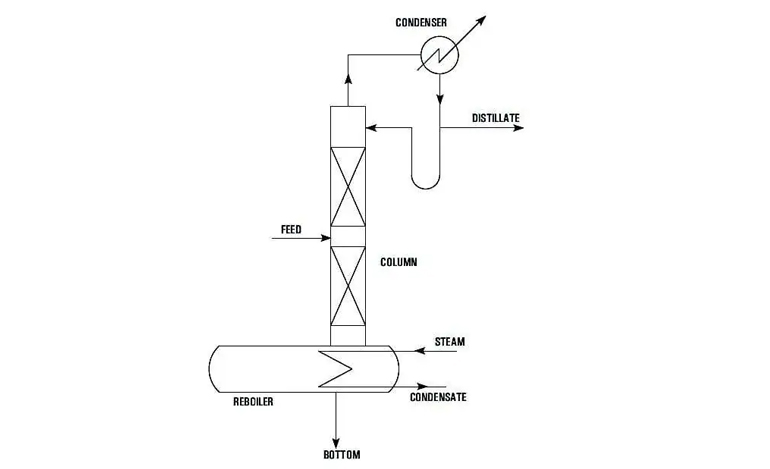
A continuous distillation system feeds the mixture into a column without stopping. Vapour rises from a reboiler at the bottom, liquid returns from the condenser and reflux at the top, and the two meet over packing or trays. The section above the feed point (the rectifying section) purifies the light product. The section below it (the stripping section) cleans up the heavy product. Top and bottom products are drawn off all the time.
Once flows and temperatures settle, nothing inside the column changes, and that steady state is the whole point. Every piece of continuous distillation equipment, from the column to the condenser and reboiler, is designed for one uniform load. That makes the system easier to run, cheaper on utilities, and more consistent in product quality.
Batch vs Continuous Distillation: Key Differences
| Aspect | Batch distillation | Continuous distillation |
| How feed enters | Charged all at once | Fed steadily into the column |
| Composition inside | Changes throughout the run | Constant once at steady state |
| Products per column | Several cuts, one after another | Two (top and bottom) |
| Product quality | Can drift between cuts and batches | Uniform once stable |
| Flexibility | High, one unit handles many mixtures | Built around one feed |
| Capacity limit | Set by the size of the still | Set by column size and feed rate |
| Energy use | Repeated heat-up and cool-down | Steady, lower heat duty for larger volumes |
| Operator attention | High at start-up, cut changes and shutdown | Low once running |
| Capital cost | Lower | Higher |
| Operating cost per kg | Higher | Lower |
| Best for | Small volumes, campaigns, changing feeds | Steady, repeating feeds |
The capacity point catches people out. As R.C. Costello puts it, the size of the still pot sets the batch size, while a continuous process has no such limit. Want more throughput from a batch unit? You need a bigger still or more shifts. A continuous column simply runs at a higher feed rate, within its design range.
When Batch Distillation Is Still the Right Choice
Batch distillation still earns its place, and plenty of plants should keep it.
The biggest reason is flexibility. An AIChE comparison of the two methods notes that many smaller chemical plants run batch rectifiers because they make different chemicals in the same equipment in one- or two-week campaigns, which is how most specialty chemicals are produced. Costello makes the same point for solvent recovery: when the feed composition changes with every batch, batch distillation handles it far more easily.
Small volumes are the second case. A continuous column needs a steady feed to stay at steady state. If you only collect enough waste solvent for a two-day run every fortnight, keep the batch still. A continuous unit on that stream would spend most of its life starting up and shutting down.
High-value, small-lot products can also favour batch. When each lot is worth far more than the steam and labour it uses, distilling and recording every lot on its own is often worth the extra cost.
Signs Your Plant Has Outgrown Batch Distillation
Look for these patterns in your own plant:
- The same mixture goes through the still five or more days a week.
- Operators spend more time on heat-up, cool-down, cleaning, and changeovers than on actual distilling.
- Recovered solvent purity varies from batch to batch, and QC holds keep creeping up.
- You still buy fresh solvent because recovery can’t keep pace with production.
- The still’s steam bill keeps rising because every batch starts from cold.
Batch operation has quieter costs too. The AIChE comparison points out that it can be hard to judge exactly when to switch from one cut to the next. Costello adds that intermediate material from each cut change goes to a slops receiver for reprocessing, and every new batch carries some risk of contamination from the last one.
Knowing when to switch from batch to continuous distillation comes down to these patterns. If three or more of them sound familiar, it’s time to run the numbers.
Is There a Middle Ground Between Batch and Continuous?
Yes, and many plants start here. The choice is rarely all or nothing.
The simplest step is to upgrade the batch still itself. Adding a packed column and a reflux divider above an existing still sharpens every cut, so purity improves without changing how the plant is run day to day.
Another option is campaign-style continuous operation. Waste solvent collects in a buffer tank over a week or two, then a continuous column works through it in one steady run. That suits a regular stream that isn’t quite big enough to justify running the column every day, and it still gives the steady-state purity that batch struggles to match.
A third route is one continuous column shared between a few similar streams, such as two alcohols recovered in separate campaigns with a flush in between. It works when the streams behave alike, and the column is designed with enough range to handle both.
Energy, Labour and Cost: How the Two Compare
Start with energy. Every batch heats the whole charge from cold, holds it at temperature, then lets it cool. A continuous column heats the feed once and stays hot. A 1997 comparison of energy consumption in batch and continuous distillation, still cited in later patents, found that batch needs much more heat duty for the same separation.
Labour follows the same pattern. Batch distillation needs more hands-on attention at start-up, cut changes, and shutdown, so labour costs run higher. Continuous systems cost more to build, but their operating costs are generally lower. GEA puts it simply: for larger units, a continuous plant is usually more energy efficient and economical.
A quick way to estimate payback
You don’t need a consultant for a first estimate. Add up what a continuous unit would save each year: solvent you no longer buy, waste you no longer pay to dispose of, steam saved, and operator hours freed. Then compare that figure with the installed cost.
Here’s an illustrative example for large-scale solvent distillation. Say a plant produces 1,000 kg of waste solvent a day and a continuous unit recovers 90% of it. That’s 900 kg a day, or 270 tonnes a year over 300 operating days, that you don’t have to buy fresh, plus about 270 tonnes less waste to send for disposal. Multiply those two figures by your own solvent price and disposal cost. If the first-pass payback comes out under two years, the project deserves a detailed study.
Solvent Recovery: Where the Switch Pays Off Fastest
Solvent recovery distillation is the most common reason plants move to continuous operation, and the numbers explain why. Solvents such as acetone, methanol, xylene, and butyl acetate are used in large quantities, and once contaminated, they cost money twice: once to replace and again to dispose of. Goel Impex designs solvent recovery plants for capacities from a few kilograms a day to many tonnes a day.
Published pharma research shows what a well-designed continuous distillation system for solvent recovery can deliver. In a 2020 study published in Organic Process Research & Development, covering an integrated continuous manufacturing line, recovered solvent purities were above 99.9 wt% for the first solvent and above 99.8 wt% for the second, with recovery yields of 94.9% and 98.3%. The continuous process also generated about 30% less waste than the matching batch process. Pfizer reports that solvent recovery at its Kalamazoo site saved $65 million between 2006 and 2009, and the company has also studied a small continuous recovery system for acetonitrile, isopropanol and toluene waste streams there.
In India, the pressure is growing. Large pharma companies such as Cipla, Dr. Reddy’s and Lupin already recycle solvents and run zero-liquid-discharge systems, while many smaller manufacturers still lag. The CPCB has also published a standard operating procedure (2016) for recovering and reusing spent solvents, covering common solvents such as toluene, methanol, acetone and isopropyl alcohol from drug and pharmaceutical production. Market data points the same way: in the recycled pharma solvent market, fractional distillation is the leading recovery method with a 52% share, and India is its fastest-growing country, at a projected 10.7% a year.
Typical Applications: Which Method Fits Which Job?
| Application | Usual choice | Why |
| Solvent recovery from a steady production line | Continuous | The same feed arrives every day, so savings on solvent and disposal add up fast |
| Solvent recovery across many products or small lots | Batch | The feed composition changes from one batch to the next |
| Purifying API intermediates in campaigns | Batch | Short runs, frequent product changes and lot-by-lot records |
| Acid concentration and recovery (sulphuric, nitric) | Continuous | Large, steady flows that run around the clock |
| Essential oil extraction from plant material | Batch (steam distillation) | Plant material is loaded and distilled one charge at a time |
| Bulk solvents and petrochemicals | Continuous | Very large, stable volumes |
Essential oils are a good example of a job that stays batch by nature, because the raw material is solid plant matter loaded into the still in lots. Our guide to steam distillation yields by crop covers that process in detail.
What Data Do You Need Before Designing a Continuous Column?
This is where most conversion projects slip. You can’t size a column from “we recover about two tonnes of methanol a day.” Good continuous distillation column design starts with:
- The feed composition, including its range. The worst week matters more than the average.
- The flow rate, and whether the feed arrives steadily or in surges (surges call for a buffer tank).
- Target purity for the top and bottom products.
- Vapour-liquid equilibrium (VLE) data, and whether any solvent pairs form an azeotrope, which simple distillation cannot cross.
- Heat sensitivity of the products, which may call for vacuum operation.
- Corrosiveness and trace impurities, which decide the material of construction.
Recent pharma research gives a useful test for whether a stream suits continuous distillation. It looks for a large boiling point difference between solvent and impurity, a large difference in relative volatility, no azeotrope, high-boiling products, and products that don’t degrade at the distillation temperature. The more of those boxes your stream ticks, the simpler the column.
Where reliable VLE data doesn’t exist, measure it. In the study mentioned above, the team built a simple VLE setup, measured data for their two-solvent system, and designed the columns from those results.
Multicomponent Mixtures: How Many Columns Do You Need?
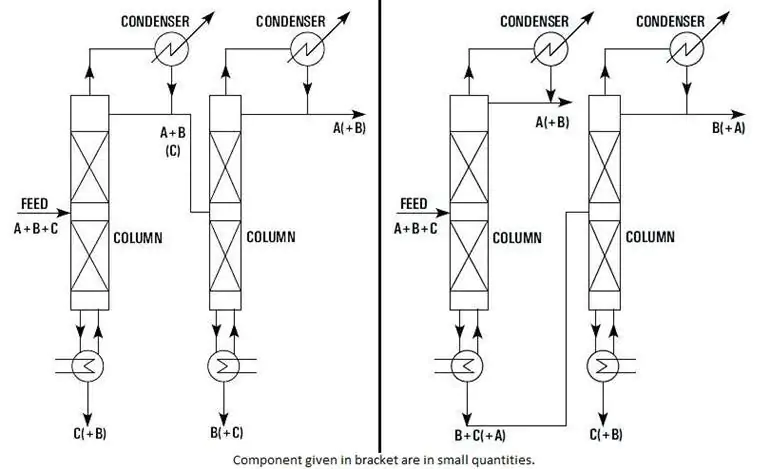
A simple continuous column makes two products, one from the top and one from the bottom. So a mixture with more components needs more columns. The rule is n-1: to separate n components, you need n-1 columns. A three-solvent waste stream needs two columns in series, and a four-component stream needs three.
The order of separation matters too, because it affects energy use and column size. For a three-component mixture where component A is the most volatile, a common choice is to take A off first, so it only has to be vaporized once. Sequencing like this is a core part of any industrial distillation system design, and it should be settled early, before the columns are sized. Continuous fractional distillation of three or more solvents is very workable, as long as the sequence is planned before the equipment is ordered.
Heat-Sensitive Products: Vacuum Operation and Residence Time
Both methods can run under vacuum, which lowers boiling points and protects products that break down when heated. But they treat heat-sensitive material very differently.
In a batch still, the whole charge sits in the pot for the length of the run, often several hours, and the heaviest fraction spends the longest time at the highest temperature. In a continuous column, material passes through steadily, and only a small hold-up sits in the reboiler at any moment. For products that degrade with time at temperature, that shorter exposure can make a noticeable difference to yield and colour.
For the most sensitive materials, such as vitamins, hormones, enzymes and aromatic compounds, even a column reboiler can be too harsh. A thin-film unit like a wiping film evaporator works under vacuum with a very short residence time, and Goel builds these in glass from laboratory size (DN 80) up to production size (DN 300).
What a Glass Continuous Distillation System Includes
Here’s how a typical Goel Impex solvent recovery unit is laid out, taking acetone recovery as the example. A regulated flow of feed goes from an overhead vessel into the distillation column. That vessel has its own vent condenser on chilled water to stop acetone vapour from escaping. The reboiler at the bottom of the column, in this case a steam-heated oil bath, supplies the vapour. Vapour from the top passes through a primary condenser on cooling water and a secondary condenser on chilled water. Part of the condensate goes back to the column as reflux, and the rest is drawn off continuously to a receiver, which also has a vent condenser. The residue drains continuously from the reboiler.
In general, a glass distillation system brings together:
- A feed vessel and, where useful, a feed preheater
- A glass distillation column filled with packing
- A reboiler to generate vapour at the bottom
- Condensers at the top, often a glass shell and tube heat exchanger
- A reflux divider to control how much liquid returns to the column
- Product coolers, receivers and vent condensers
- A vacuum system where products need lower boiling temperatures
Packing choice sets the column height and separation efficiency, so it deserves proper attention. Our guides to column packing and Raschig rings cover the options. If the stream is corrosive, the condenser material matters just as much, and our comparison of glass vs graphite vs SiC heat exchangers for acid service explains how to choose.
Why Glass Works Well for Batch and Continuous Distillation
Borosilicate glass 3.3 resists almost every acid and solvent a chemical or pharma plant uses, and it keeps products free of metal contamination, which matters for APIs. Just as useful, operators can see inside. Flooding, weeping, foaming, or a colour change in the column shows up the moment it starts, which makes commissioning a new continuous unit far less stressful.
Glass is also naturally modular. The same standard components, such as column sections, condensers, valves and couplings, build everything from a kilo lab rig to a production unit. That makes a glass modular distillation system easy to test at small scale, then expand. Goel has built glass column components up to DN 800 for larger duties.
There are honest limits. Glass columns run under vacuum or at low pressure, and for very large tonnages, such as refinery or bulk petrochemical duties, metal columns make more sense. For the volumes typical of pharma, fine chemicals, and solvent recovery, glass fits well.
Safety, Emissions and Day-to-Day Operation
A continuous unit typically holds much less hot, flammable solvent at any moment than a large batch still. The column and reboiler only contain a working hold-up, while a batch still holds the full charge at temperature for hours. In solvent service, that smaller inventory is a clear safety advantage.
Emissions are easier to control too. Vent condensers on the feed vessel and receivers, like the chilled-water units in the acetone example above, stop solvent vapour escaping to air. In India, emission limits for solvent recovery units are set through state pollution control board consent conditions, so tight vapour control helps a plant stay within its consent.
Continuous operation also cuts the number of manual charging, draining, and transfer steps, which is where many spills and exposures happen in a solvent area. Whichever route you choose, solvent areas still need flameproof motors and instruments, proper earthing and good ventilation.
How to Convert a Batch Distillation Process to Continuous
Converting batch distillation systems to continuous operation is one of the technical packages Goel Impex designs and supplies, along with troubleshooting for plants that already run one. If you’re working out how to convert batch distillation to continuous, the work tends to follow five steps:
- Collect real data from your batch runs: feed composition logs, cut temperatures, yields, and rejects.
- Confirm the separation with VLE checks and lab or pilot trials, especially if azeotropes or heat-sensitive products are involved.
- Size the column: diameter from the flow rate, height from the number of stages, packing type, and reflux ratio.
- Decide what to reuse. Condensers, receivers,s and the vacuum system can sometimes stay, while the column, reboiler,er and controls are usually redesigned for steady-state duty.
- Build, install, and commission with the actual feed, then tune the continuous distillation process until it holds purity at the design rate.
A pilot plant trial is worth its cost on any new separation. It confirms the number of stages, how the column behaves with the impurities in your own stream, and whether the purity target is realistic, before anyone orders full-size equipment.
Mistakes That Sink Batch to Continuous Projects
The most common one is designing for the average feed. If the composition swings from week to week, the column needs design margin, or a buffer tank that blends the feed before it goes in.
Skipping the azeotrope check comes next. Finding out after installation that two solvents form an azeotrope, as ethanol and water do, is an expensive lesson. A simple column will never get past it.
Then there’s underinvesting in controls. A continuous unit only runs itself when flow, temperature, level, and reflux control are set up properly, so budget for good instrumentation from day one.
And the quietest mistake is converting a stream that was never steady enough. If the feed only arrives a few days a month, the plant ends up with an expensive continuous unit run as a batch still.
Where Goel Impex Distillation Systems Work Today
Goel Impex designs, builds and commissions glass distillation units in Vadodara, Gujarat, drawing on more than four decades of glass process equipment experience from our family business, Goel Scientific Glass Works Ltd. As a continuous distillation system manufacturer in India, we work with chemical and pharma plants across the country and export to customers in more than 80 countries, with Europe, the USA and Asia among our key markets. Our process engineers handle the whole job, from reviewing batch data and sizing the column to supplying the complete unit and troubleshooting plants that are already running.
Distillation and stripping columns sit at the heart of many of our process packages, including HCl purification, nitric acid concentration, bromine recovery and sulphuric acid concentration. One of our sulphuric acid concentration plants handles 800 kg/hr, taking acid from 70% to 95%.
Our glass components are made from borosilicate glass 3.3 to ISO 3585, and the assembled parts are designed and tested to ISO 3586, EN BS 1595 and AD 2000 Merkblatt, with CE certification available. The company holds ISO 9001:2015 certification, is recognised as a One Star Export House and is a 2026 member of HTRI (Heat Transfer Research, Inc.).
Planning a Switch? Talk to Our Process Engineers
Share your feed composition, daily volume, and purity target. The Goel Impex process team will tell you whether continuous distillation makes sense for your stream, what the system would look like, and whether a pilot trial is the right first step. If batch is still the better fit, we’ll say so.
Discuss Your Distillation Project →
Call +91 98253 18944 or email anshul@goelequipments.com.





One reply on “Batch vs Continuous Distillation: Which Separation System Is Right for Chemical and Pharma Plants?”
[…] covers that side of the design). If you are still deciding how that column should run, our guide on batch vs continuous distillation walks through the choice for chemical and pharma […]