©2026 Goel Impex.
All Rights Reserved.
Design By : Ads Media Solutions
Blog
Batch vs Continuous Distillation: Which Separation System Is Right for Chemical and Pharma Plants?
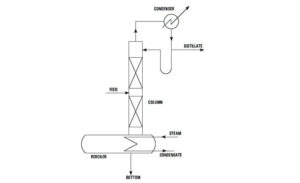
TL;DR Batch distillation suits small volumes, frequent product changes, and multi-product plants. A continuous distillation system suits one steady feed that runs most days of the week, and it gives more uniform purity with less energy and labour per kilogram. Solvent recovery is where the switch usually pays back fastest. Before switching, collect real feed […]
Read More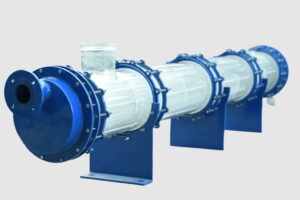
Glass vs Graphite vs SiC: Which Tube and Shell Material Works Best for a Heat Exchanger in Acid Service?
TL;DR For acid service below 150°C and at low pressure, a borosilicate glass shell and tube heat exchanger is the best heat exchanger material for acid service on corrosion resistance and cost. Pick graphite for hydrofluoric or hot phosphoric acid. Pick silicon carbide (SiC) for high pressure, high temperature, or HF service (directly sintered grades […]
Read More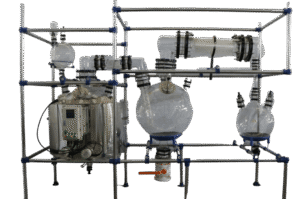
Steam Distillation Yields by Crop: Process, Cycle Times and Unit Sizing
Steam distillation is the method used to produce most of the world’s essential oils. Steam passes through plant material; the heat releases volatile aromatic compounds, and those compounds travel with the vapour into a condenser where both return to liquid. The oil floats, the water sinks, and you separate the two. That is the whole […]
Read More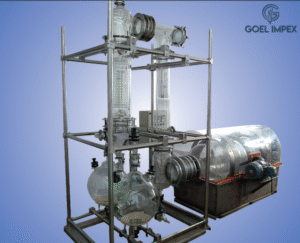
Vacuum Evaporator Types Compared: The Principle, the Options and Where Each One Fits
Ask three engineers what a vacuum evaporator is, and you will get three different machines. One pictures a rotovap in a lab. One pictures a falling-film unit recovering ethanol at 500 litres per day. One pictures an effluent treatment skid. All three are right, which is exactly the problem when you are trying to specify […]
Read More
What Is Borosilicate Glassware? Properties, Benefits & Applications
Glassware plays a quiet but powerful role in modern industry. From chemical plants and laboratories to food processing and pharmaceutical production, certain materials must handle heat, pressure, and aggressive chemicals without breaking down. One material stands out for its strength and reliability: borosilicate glassware. You’ve probably seen it without realizing it. Laboratory flasks, chemical reactors, […]
Read More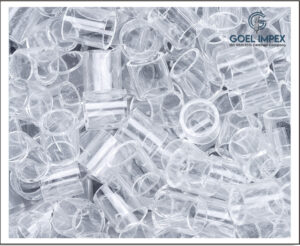
What Are Raschig Rings? Uses, Materials, and Benefits Explained
If you’ve ever walked through a chemical plant or stood near a distillation unit, you’ve probably seen those small, cylindrical pieces packed tightly inside large vertical columns. Most people walk right past them without a second thought. But those little rings, known as Raschig rings, are doing some seriously important work inside those towers. They […]
Read More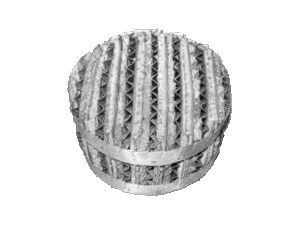
What Is Packed Column? A Complete Guide for Chemical and Process Industries
If you work in a chemical plant, a pharmaceutical lab, or any facility that runs distillation or separation processes, you’ve almost certainly come across the term column packing. But what exactly is it? Why does it matter so much? And how do you pick the right material for the job? This guide covers all of […]
Read More
What Is Scientific Grade Glass? Applications in Laboratories and Industry
When you hear the word scientific glass, you might think of beakers and test tubes in a lab. That’s part of it. But scientific glass is much more than that. From school labs to big research centers and production-scale factories, scientific glass plays a key role in experiments, testing, and production. I’ll explain what scientific glass […]
Read More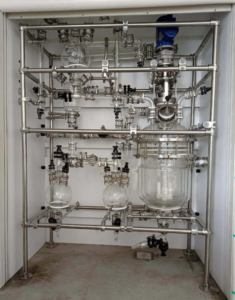
The Importance of Pilot Scale Plants in the Pharmaceutical and Chemical Industries
Introduction Moving from laboratory research to full-scale production is crucial in the pharmaceutical and chemical industries. This transition requires careful planning, testing, and evaluation to ensure efficiency and safety. This is where pilot plants play a vital role. These small-scale production units help bridge the gap between research and large-scale manufacturing, optimizing. processes before full-scale […]
Read More