
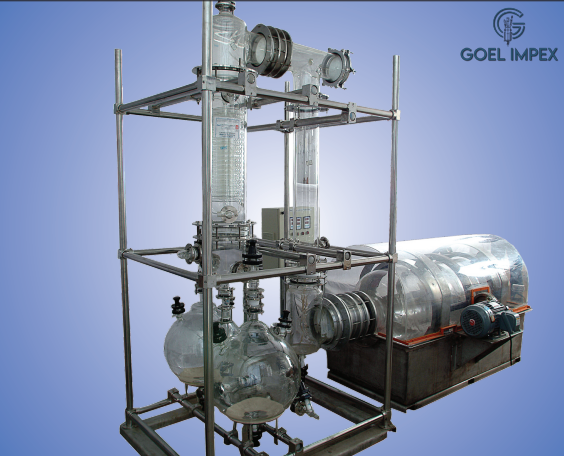
Ask three engineers what a vacuum evaporator is, and you will get three different machines. One pictures a rotovap in a lab. One pictures a falling-film unit recovering ethanol at 500 litres per day. One pictures an effluent treatment skid.
All three are right, which is exactly the problem when you are trying to specify equipment. This article sorts out what vacuum evaporation actually is, what the main types of evaporator do differently, and how to work out which one belongs in your plant.
What is vacuum evaporation?
Vacuum evaporation is the removal of a liquid from a solution by boiling it under reduced pressure instead of at atmospheric pressure. Lowering the pressure lowers the boiling point, so the separation happens at a temperature the material can survive.
That is the whole idea. Everything else- the rotating flasks, the falling films, the multiple effects- is engineering built around that one principle.
The principle: why dropping the pressure changes everything
A liquid boils when its vapour pressure matches the pressure above it. Reduce the pressure above it, and it boils sooner, at a lower temperature.
The numbers make the point better than the explanation does. Approximate vacuum levels needed to bring common solvents to a 40°C boiling point:
| Solvent | Boiling point at 1013 mbar | Vacuum needed to boil at 40°C |
| Dichloromethane | 40°C | 850 mbar |
| Acetone | 56°C | 556 mbar |
| Chloroform | 61°C | 474 mbar |
| Methanol | 65°C | 337 mbar |
| n-Hexane | 69°C | 335 mbar |
| Ethyl acetate | 77°C | 240 mbar |
| Ethanol | 79°C | 175 mbar |
| Isopropanol | 82°C | 137 mbar |
| Water | 100°C | 72 mbar |
| Toluene | 111°C | 77 mbar |
Water at 72 mbar boils at 40°C. Toluene, which needs 111°C in an open vessel, comes over at the same 40°C once you pull down to 77 mbar.
For anything thermally sensitive, that gap between 111 and 40 is the difference between a product and a degraded mess. It is why vacuum evaporation dominates in pharmaceutical concentration, natural product extraction, and food processing, where the material will not tolerate the heat that atmospheric distillation demands.
There is a working rule most operators use, sometimes called the delta 20 rule. Set the heating bath 20°C above your target vapour temperature, and the condenser 20°C below it. Bath at 60, vapour at 40, condenser at 0. It is a starting point rather than gospel, but it gets a new operator to a stable run faster than trial and error.
Two different technologies, one confusing name
This section exists because the confusion costs people real time.
Search for vacuum evaporation, and you will find two entirely unrelated industries using nearly the same words.
Vacuum evaporation as covered in this article is a thermal separation process. You have a liquid mixture, you want to remove one component, and you use reduced pressure to do it gently. This is process equipment for chemical, pharmaceutical, food, and effluent applications.
Vacuum evaporation deposition, also called thermal evaporation or physical vapour deposition, is a coating process. A source material is heated inside a high vacuum chamber until it vaporises and condenses as a thin film on a substrate. It is used in semiconductor fabrication, optical coatings, and display manufacturing. Different equipment, different suppliers, different buyers.
If you landed here looking for thin film coating chambers, you want a PVD equipment supplier. Everything below is process evaporation.
Which evaporator does what
Rotary vacuum evaporator
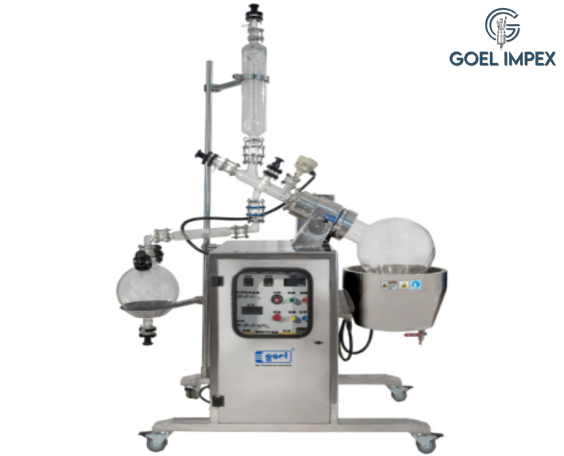
The one most people picture. A flask containing the sample rotates in a heated bath, spreading the liquid as a thin film across the inner wall. That film gives a large surface area for heat transfer, and the rotation prevents local overheating and reduces bumping.
Vapour travels through a hollow shaft to a condenser and collects in a receiver flask. Batch operation, one charge at a time.
It is the most flexible machine on this list. Change solvent, change batch size, change process, and the same unit handles it. That flexibility is why R&D departments and multi-product plants buy them, and why they are the default in pharmaceutical development work.
The rotary vacuum evaporator range we build at Goel Impex runs from 2-litre bench units up to 50 litres as standard, with larger capacities available on request.
| Model | Rotating flask | Speed | Motor | Condenser area | Receiver |
| GRFE2 | 2 L | 0 to 80 rpm | 40 W | 0.15 m² | 1 L |
| GRFE5 | 5 L | 0 to 80 rpm | 40 W | 0.15 m² | 2 L |
| GRFE10 | 10 L | 0 to 80 rpm | 0.25 HP | 0.20 m² | 5 L |
| GRFE20 | 20 L | 0 to 80 rpm | 0.25 HP | 0.30 m² | 10 L |
| GRFE50 | 50 L | 0 to 80 rpm | 0.25 HP | 0.50 m² | 20 L |
Above 50 litres, the design changes character, and our large capacity rotary film evaporators cover that range.
Falling film evaporator
Feed enters at the top of a bundle of vertical tubes and runs down the inner walls as a thin film while heat is applied from outside. Vapour and concentrate are separated at the bottom. Continuous operation, no batching.
Residence time is short, often seconds, which suits heat-sensitive material. Throughput is high once the unit is running. The trade is inflexibility. A falling film evaporator is tuned for a specific duty, and switching solvents or feed characteristics is not a five-minute job.
Wiped film evaporator
Also called an agitated thin film evaporator. Rotating blades mechanically spread the feed across the heated wall in a very thin, constantly renewed film.
This is the machine for material that will not behave. High viscosity, fouling tendency, solids content, or a boiling point so high that even under vacuum you are close to degradation. Short path variants push this further by placing the condenser inside the evaporation chamber, cutting the vapour travel distance so you can work at very low pressures.
Expensive, mechanically complex, and worth it when nothing else will run.
Forced circulation evaporator
A pump circulates liquid through a heat exchanger at velocity high enough to suppress boiling inside the tubes. Flashing happens in a separate vessel. Used where the feed fouls or crystallises, since the high velocity keeps surfaces clear.
Multiple effect evaporator
Several evaporator bodies in series, each running at lower pressure than the one before. Vapour from the first effect becomes the heating medium for the second, and so on.
Energy performance is excellent. A triple effect uses roughly a third of the steam of a single effect for the same duty. The honest caveat is that capital cost and complexity scale with every effect you add, and the payback only works at continuous high volume. Plenty of plants have bought a multiple effect system for a batch process and never recovered the difference.
Vacuum pan evaporator
A batch vessel operating under vacuum, traditionally used in sugar refining and crystallisation work. Simple, well understood, and still the right answer for certain crystallisation duties.
Choosing between them
Most of the decision comes down to two questions. How much are you processing per day, and does the process change often?
| Rotary | Falling film | Wiped film | |
| Operation | Batch | Continuous | Continuous |
| Typical duty | Up to around 200 L/day solvent | 200 L/day and above | Difficult feeds, any volume |
| Residence time | Minutes | Seconds | Seconds |
| Flexibility | High | Low | Moderate |
| Capital cost | Low | Moderate to high | High |
| Operator time | Significant | Minimal | Low |
| Best for | R&D, multi-product, variable feed | Single solvent, steady high volume | Viscous, fouling, thermolabile |
The throughput figures deserve a caveat, because the real driver is labour rather than litres. A rotary evaporator needs a charge and discharge cycle every 30 to 60 minutes, and analysis of working labs puts the time lost to that handling at 15 to 25% of the day. Under about 200 litres a day of solvent recovery, that cost is acceptable, and the flexibility is worth having. Past 400 to 500 litres a day, a falling film unit almost always wins on total cost.
Our own view, and it is a lopsided one: rotary evaporators get oversold above 200 litres a day and undersold below it. Plants scale up to continuous systems too early, then discover they have bought a machine tuned for one solvent while their product mix keeps changing. If your process is still moving, stay batch longer than feels comfortable.
Where vacuum evaporation is used
Pharmaceutical and API manufacturing
Concentrating extracts, recovering reaction solvents, and drying heat-sensitive intermediates. Solvent recovery is drawing more attention in Indian pharma clusters as regulatory pressure builds around residual solvents and waste, and Vadodara sits in the middle of that shift.
Chemical processing
Recovering and reusing process solvents, concentrating intermediates, and separating close-boiling mixtures that atmospheric distillation cannot handle without decomposition. Frequently installed downstream of a glass reactor as part of a continuous train.
Food and beverage
Juice and dairy concentration, aroma recovery, and any duty where flavour compounds would be lost to heat. This overlaps with botanical work, where a rotary film evaporator is used to concentrate extracts after steam distillation yields without putting the material through a second thermal cycle.
Effluent treatment and zero liquid discharge
Evaporating water out of industrial effluent to reduce discharge volume and recover reusable water. Different design priorities from laboratory work, since fouling and scaling dominate, which is why forced circulation and falling film designs are common here rather than rotary units.
The vacuum system is half the equipment
An evaporator is only as good as the vacuum behind it, and this is where most disappointing installations go wrong.
Pump type: Chemical duty diaphragm pumps are corrosion-resistant and typically reach around 5 to 10 mbar, adequate for most common solvents. Rotary vane pumps go deeper, into the 0.1 mbar range, but need oil changes and a good trap to survive solvent exposure.
Vacuum control: A controller that holds a setpoint instead of pulling to full vacuum makes a large difference. Uncontrolled vacuum causes bumping and foaming, which puts your product in the condenser.
Leak tightness: Say a system is underperforming and most people blame the pump. In our experience, it is usually a joint. A single loose ground joint or a tired PTFE seal will stop you reaching setpoint no matter what pump is fitted.
Condenser capacity: Undersized condensers let vapour through to the pump, which damages the pump and loses you solvent. Condenser sizing should follow the evaporation rate, not the flask volume, and our glass heat exchangers are specified that way.
Why material choice matters
Borosilicate glass is the standard for evaporation equipment in chemical and pharmaceutical service for reasons that hold up under scrutiny.
It resists nearly all acids, solvents, and process chemicals, so there is no contamination path into the product and no corrosion path into the equipment. It handles the thermal cycling that evaporation involves. And it is transparent, which matters more than it sounds. An operator can see foaming start, see the film forming, and see when a flask is running dry. On a steel vessel, all of that is invisible until an alarm goes off.
Full thermal and chemical resistance data sits on our technical information page, and the wider case for the material is covered in our article on borosilicate glass.
Four reasons a vacuum evaporator underperforms
Bath temperature set too high: Raising the bath rarely fixes a slow run and usually causes bumping. Improve the vacuum instead.
Vacuum applied too fast at the start: Ramp it. Slamming a full charge to setpoint is how product ends up in the receiver.
Condenser too warm: Coolant should sit around 20°C below the vapour temperature. Chiller capacity gets ignored during specification more often than any other component.
Flask overfilled: Half full is the working maximum on a rotary unit. Beyond that, the film cannot form properly, and evaporation rate drops even though you have loaded more material.
Talk to the Goel Impex team
Specifying evaporation equipment goes wrong at the same point most times: the system gets sized on flask volume rather than on daily throughput and solvent load.
Send us what you are actually processing. The solvent, the volume per day, the feed temperature, and whether the process is likely to change. We will come back with a recommended configuration, condenser sizing, and a vacuum system matched to it.
Goel Impex has built borosilicate glass process equipment from Vadodara for over two decades, supplying pharmaceutical, chemical, and food processing plants in India and export markets. For larger installations, our turnkey projects team handles design through to commissioning.
Send us your process details and our engineers will respond with a technical proposal.