
TL;DR
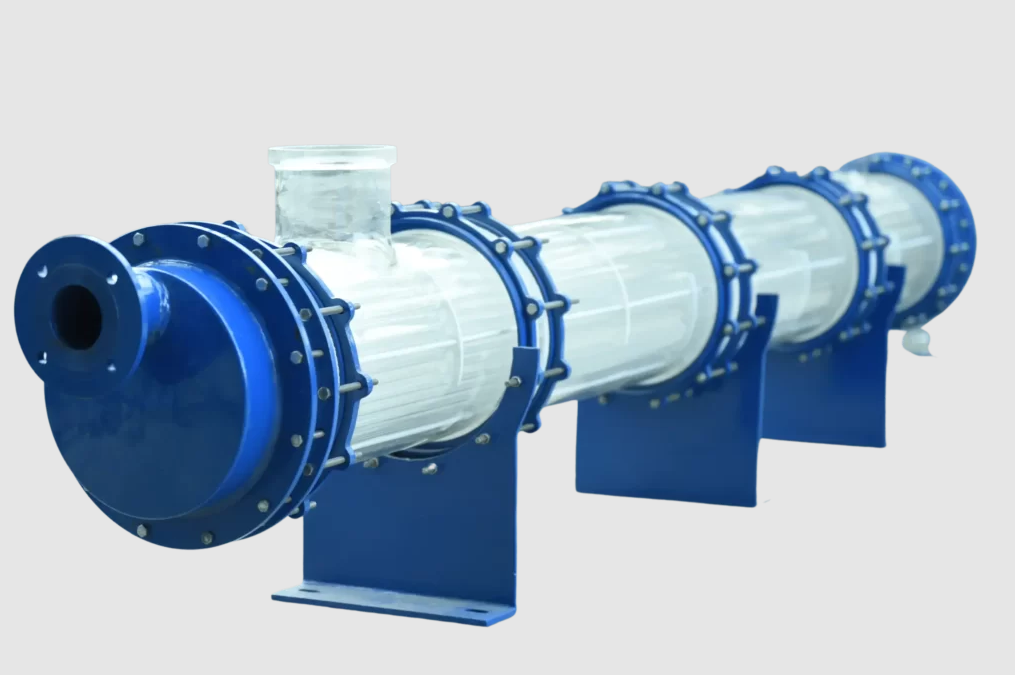
For acid service below 150°C and at low pressure, a borosilicate glass shell and tube heat exchanger is the best heat exchanger material for acid service on corrosion resistance and cost. Pick graphite for hydrofluoric or hot phosphoric acid. Pick silicon carbide (SiC) for high pressure, high temperature, or HF service (directly sintered grades only) when the budget allows. Only the side that touches the acid needs the special material, which is where most plants can save money.
A shell and tube heat exchanger in acid service rarely fails because someone got the sizing wrong. It fails at the tube wall. A pinhole, a hairline crack, a gasket that slowly gave up. Trace almost any of those failures back far enough, and you land on one early decision: what the tubes, and the shell around them, were made of.
For most chemical plants today, that choice comes down to three materials: borosilicate glass, impregnated graphite and silicon carbide (SiC). In the chemical estates of Gujarat, from Ankleshwar and Dahej to Vapi, all three are in daily use. Indian suppliers now offer them side by side too, and some sell shell and tube units with glass, graphite and silicon carbide tubes from the same catalogue. So buyers are comparing them more than ever, and each material comes with a sales pitch that sounds convincing.
We manufacture glass heat exchangers at Goel Impex in Vadodara, so you might expect us to say glass always wins. For a large share of acid duties, it does. For some, it clearly doesn’t, and this guide tells you which is which.
Which Material Is Best for a Heat Exchanger in Acid Service?
For most acid duties below 150°C and at low pressure (HCl, sulphuric acid, nitric acid, wet chlorine, bromine and mixed solvents), a borosilicate glass shell and tube heat exchanger gives the widest corrosion resistance at the lowest cost. Choose graphite for hydrofluoric acid or hot phosphoric acid. Choose a SiC heat exchanger when you need high pressure, higher temperatures, or the best heat transfer, and the budget allows it. When you need a truly corrosion-resistant heat exchanger, the heat exchanger tube material matters more than any other spec on the datasheet.
Why Acid Service Changes the Whole Decision
In clean water or oil service, you pick a heat exchanger for heat duty and price. Material is an afterthought.
Acid service flips that. The tube wall is the only thing standing between a corrosive process stream and your cooling water, so if that wall thins or cracks, you’re dealing with cross-contamination, a plant shutdown, and possibly a safety incident. Carbon steel is out. Even stainless steel pits badly in chloride-bearing acids. The real choice is between materials that barely react at all.
Researchers have noted the same thing. A published study comparing glass and SiC exchangers pointed out that where strong corrosion rules out metals, glass heat exchangers are usually the default. The question is whether that default suits your duty.
Glass vs Graphite vs SiC at a Glance
| Property | Borosilicate glass 3.3 | Impregnated graphite | Sintered silicon carbide |
| Corrosion resistance | Resists almost all acids, halogens and solvents | Very good with non-oxidising acids | Near universal |
| Weak against | HF, fluorides, hot strong caustic, hot concentrated phosphoric acid | Oxidising media such as nitric acid, chlorine and bromine; strong alkalis | Some grades weak with HF or hot caustic |
| Tube wall conductivity | Low (about 1.2 W/m·K) | High | High |
| Pressure range | Low | Medium | Medium to high |
| Temperature limit | 150°C in the Goel Impex range | About 200°C (resin grade) | Usually set by gaskets |
| Fouling | Very low, glass-smooth surface | Low | Low |
| Can you see inside? | Yes | No | No |
| Relative price | Lowest | Medium | Highest of the three |
Borosilicate Glass: Our First Choice for Acid Service Below 150°C
Glass has one quality nothing else matches at its price. It shrugs off almost every acid and solvent in a typical chemical or pharma plant: hot dilute HCl, sulphuric acid at any strength, nitric acid, wet chlorine, bromine, and mixed organic streams. No pitting and no slow thinning of the wall. A well-handled glass tube looks the same after ten years as it did on day one.
That’s why a borosilicate glass heat exchanger is such a common sight in the bulk drug plants around Hyderabad and the dye and intermediate units across Gujarat. Their process streams change often, and glass handles almost anything they throw at it.
How the Goel Impex Glass Shell and Tube Heat Exchanger Is Built
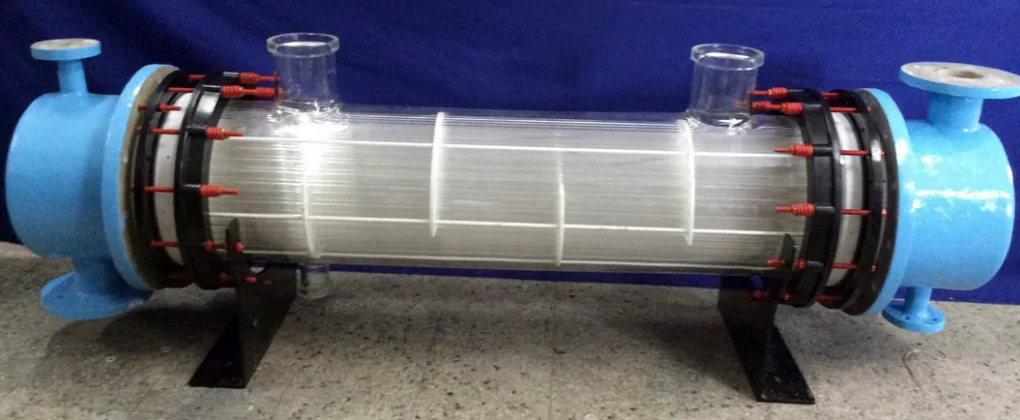
Our own glass shell and tube heat exchanger uses SCHOTT DURAN borosilicate glass 3.3 tubes. Each tube is sealed on its own into a PTFE tube sheet with PTFE sockets and packing. That single detail matters more than most buyers realise. If one tube cracks, you pull that tube and replace it. You don’t retube the whole bundle.
Here’s what the standard Goel Impex range handles:
- Temperatures from -40°C to 150°C on both shell and tube side, with up to a 120°C difference between the two sides
- Full vacuum on both sides, in every size
- Heat transfer areas from 3 m² to 25 m², built with 37, 73, or 151 tubes depending on shell size (DN 150, 225, or 300)
For bigger duties, we build custom units well beyond that. Our manufacturing arm, Goel Scientific Glass Works Ltd., has supplied glass heat exchangers up to 50 m².
Then there’s visibility, which sounds like a small thing on a spec sheet. On a night shift, being able to see condensation, fouling, or a colour change inside the exchanger saves a lot of guesswork.
Where Glass Is the Wrong Choice
Keep glass away from hydrofluoric acid and fluoride-bearing streams. The same goes for hot concentrated caustic and hot concentrated phosphoric acid. Glass also isn’t meant for duties above 150°C or for high pressure. If your process sits in that list, no glass supplier should be quoting you.
If your duty sits comfortably inside glass’s limits, though, paying several times more for SiC mostly buys peace of mind you don’t need.
Graphite Heat Exchanger: Strong With HF and Phosphoric Acid, Weak With Oxidizers
Resin-impregnated graphite has been the workhorse of acid plants for decades. A graphite shell and tube heat exchanger conducts heat well and handles hydrochloric acid, dilute sulphuric acid, hydrofluoric acid and hot phosphoric acid without much trouble. Mersen, one of the largest graphite exchanger makers, says it has supplied the largest units for the biggest greenfield phosphoric acid projects in the world. That’s the duty where graphite earns its place.
The problems start with oxidising media. Mersen’s own data rates its standard phenolic-impregnated grade as having limited resistance to nitric acid, chlorine, bromine and bases, with a maximum design temperature of 200°C. PTFE-impregnated grades cope better with mildly oxidising media, but they cost more. Those oxidising duties are exactly where glass is at its best. Graphite doesn’t forgive water hammer or careless handling either, and you lose all visibility into the process.
Our view is simple. If your stream contains fluorides or hot phosphoric acid, graphite is a sensible and proven choice. For most other acid duties, it’s worth checking whether glass would do the job for less.
Silicon Carbide (SiC) Heat Exchanger: The Best Material on Paper, and the Priciest
SiC is the material glass engineers quietly admire. Pfaudler describes it as having corrosion resistance similar to glass with far better heat conduction. That’s a fair summary.
A SiC heat exchanger also handles more pressure and heat. SGL Carbon’s SiC shell and tube units, for example, have a standard design temperature of 180°C (up to 220°C) and a design pressure of 8 barg (up to 10 barg), about 8.2 to 10.2 kg/cm²(g). CG Thermal’s design with PTFE tube sheets goes up to 150 psig at 400°F (about 10.5 kg/cm²(g) at 204°C).
So why doesn’t everyone buy SiC? Price, mostly. A SiC unit usually costs several times more than a glass unit of the same area, and lead times can be longer. The grade matters as well. Directly sintered SiC resists HF, while grades that contain free silicon do not, so always ask for the exact grade before ordering for fluoride service.
Does SiC Really Transfer Heat Much Better Than Glass?
It depends on the duty, and this is where a lot of sales pitches get slippery.
Gas Cooling
Here the gas-side film limits heat transfer, and the tube wall barely matters. A pilot plant study comparing SiC and glass tubes in air cooling expected only a 3.8 to 5.4% gain from SiC’s higher conductivity. The measured gain was 18 to 22%, but the extra came from the rougher SiC surface, which also raised the air pressure drop by 17 to 24%. For gas duties, glass performs much closer to SiC than the conductivity numbers suggest.
Condensing and Liquid-to-Liquid Duties
Here the story changes. The glass wall is a real part of the resistance, and SiC or graphite can reach noticeably higher heat transfer coefficients. For reference, the glass units we build typically reach 410 to 640 W/m²K for steam-water condensation and 290 to 410 W/m²K for water-water cooling. SiC will beat those figures.
What does that mean in practice? For liquid duties, a glass exchanger often needs more area than a SiC unit to do the same job. But glass area is cheap, and a smooth glass surface holds its performance for years because deposits don’t stick to it easily. When a supplier shows you a big heat transfer advantage for SiC, ask for the total installed cost for the same duty, not the coefficient alone. The same advice applies to any glass vs graphite heat exchanger comparison.
What About a Titanium or Tantalum Shell and Tube Heat Exchanger?
Metal still has a place in acid service. Titanium does very well with wet chlorine and oxidising chloride solutions. Tantalum is excellent with hot hydrochloric and sulphuric acids and handles pressure well.
The catch is that each metal has a blind spot. Titanium fails badly in dry chlorine and some reducing acids, and tantalum is attacked by HF and hot alkali. Both are expensive, and their prices move with the metal markets. We’d only look at a titanium shell and tube heat exchanger, or a tantalum one, when you need high pressure and a chemistry that rules out graphite and SiC. That’s a smaller group of duties than most specs suggest.
Which Material for Which Acid?
| Process fluid | Glass | Graphite | SiC |
| Hydrochloric acid (hot, dilute) | Excellent | Excellent | Excellent |
| Sulphuric acid, all strengths | Excellent | Good at lower strengths and temperatures | Excellent |
| Nitric acid | Excellent | Poor when hot or concentrated | Excellent |
| Wet chlorine | Excellent | Limited | Excellent |
| Bromine | Excellent | Limited | Excellent |
| Hydrofluoric acid / fluorides | Not suitable | Good | Good in directly sintered grades |
| Hot concentrated phosphoric acid | Not suitable | Excellent | Good |
| Hot caustic soda | Not suitable | Limited, depends on impregnation | Grade dependent |
| Mixed organic solvents | Excellent | Good | Excellent |
Tubes vs Shell: Do Both Need to Be Corrosion Resistant?
Often, no. And this is where buyers save the most money.
Only the side that touches the acid needs the special material. If your acid runs inside the tubes and plain cooling water runs through the shell, the shell can be steel or FRP. Graphite and SiC exchangers work the same way, with a steel shell around the corrosion-resistant tube bundle.
Goel Impex builds its glass shell and tube heat exchangers in three versions for exactly this reason:
| Model | Shell | Tubes | Headers | Best for |
| RGG | Glass | Glass | Glass | Acid or aggressive media on both sides |
| RGM | Glass | Glass | Steel / FRP | Aggressive media in the shell, clean utility in the tubes |
| RMG | Steel / FRP | Glass | Glass | Aggressive media in the tubes, clean cooling water in the shell |
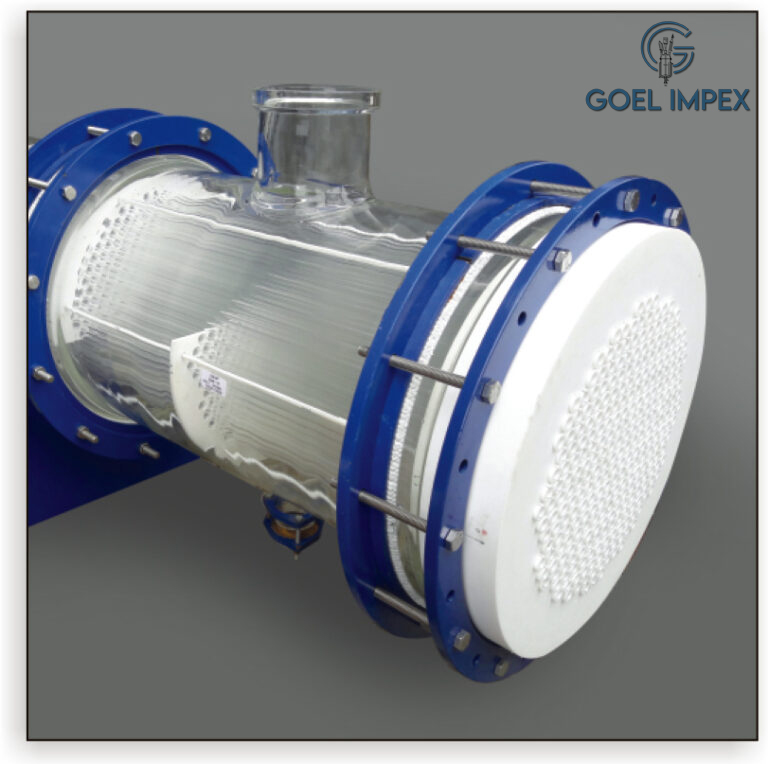 The RMG layout works especially well for condensers on glass distillation columns. Cooling water never needs glass protection, and the steel or FRP shell takes a higher shell-side pressure: up to 3.5 kg/cm²(g), compared with 1 to 2 kg/cm²(g) on all-glass units depending on size.
What If You Need a High-Pressure Shell and Tube Heat Exchanger?
Then glass is probably not your answer, and we’d rather tell you that now.
All-glass exchangers work at low pressure and full vacuum. If your duty needs several bar on the acid side, look at graphite or SiC. If it needs higher pressure on the utility side only, an RMG glass unit with a steel shell may still do the job.
One thing worth checking first. It’s common for enquiries to list a design pressure far higher than the process ever sees, often copied from an old datasheet. Confirm your real operating pressure before ruling glass out, because it can change the project cost a lot.
Cleaning and Maintenance: How Each Material Holds Up
Maintenance is where the day-to-day difference between these materials shows, and it rarely makes it into a quotation.
Glass is the easiest to live with. The smooth surface resists deposits, and because you can see inside, you know when cleaning is actually needed instead of guessing from a falling outlet temperature. Most deposits come off with a chemical wash, and almost any acid can be used for that except HF. If a tube breaks, the PTFE sealing on Goel Impex units lets you replace that one tube in the plant, usually without calling us in.
Graphite needs more care. Chemical cleaning works well, but aggressive mechanical cleaning or high-pressure jetting can damage tubes, and the resin impregnation can age over the years in hot service. A cracked graphite tube is often plugged rather than replaced, which slowly eats into your heat transfer area.
SiC is the toughest of the three. It resists abrasion and fouling well, and CG Thermal describes its SiC units as field-repairable with common tools, with single tubes replaced without disturbing their neighbours. The trade-off is that spare SiC tubes cost far more than glass ones, so a breakage hurts the maintenance budget more.
What Each Material Really Costs Over Its Life
The purchase price is only the first line of the bill. Over ten years, the picture looks more like this.
A glass exchanger has the lowest purchase price and the cheapest spares. Its real cost risk is breakage from thermal shock or impact, which good operating practice mostly removes. With the right duty, glass units run for many years with nothing more than gasket changes and the odd tube.
Graphite sits in the middle on price. Over time, resin ageing and plugged tubes gradually lower performance, so some plants budget for a retube partway through the unit’s life.
SiC costs the most upfront but lasts a very long time in the harshest duties. CG Thermal, for example, offers a lifetime guarantee against corrosion and erosion on its SiC units. If your process is hot, pressurised, and highly corrosive all at once, that longevity can justify the price. If it isn’t, you’re paying for durability you won’t use.
Our honest take: for low-pressure acid service under 150°C, glass almost always wins on total cost. The case for SiC only gets strong when pressure, temperature, or fluorides push glass out of the running.
Typical Uses of a Shell and Tube Heat Exchanger for Corrosive Fluids
In chemical and pharma plants, a shell and tube heat exchanger for corrosive fluids usually does one of a handful of jobs. It works as an overhead condenser for acid or solvent vapours on distillation columns, or as a cooler for hot HCl, chlorine, or bromine gas before absorption. It serves as a reboiler or preheater in acid recovery and concentration units, and as a product cooler for acids and aggressive intermediates before storage.
Glass fits nearly all of these at low pressure. It’s also the natural choice in pilot plants and kilo labs, where process streams change from campaign to campaign and seeing inside the equipment helps engineers understand a new process. When the same process scales into a continuous distillation system, the condensers and reboilers around the packed column are often glass exchangers too (our guide to column packing covers that side of the design). If you are still deciding how that column should run, our guide on batch vs continuous distillation walks through the choice for chemical and pharma plants.
How to Choose Shell and Tube Heat Exchanger Material: Five Questions to Answer First
Start with what’s actually in the stream. List the main acids, their concentrations, and any trace impurities. Fluorides deserve special attention, since even a few ppm can rule glass out.
Then write down your worst-case temperature and pressure, including start-up and upset conditions as well as normal running. Note which side is corrosive (the tubes, the shell, or both), because that decides whether you need an all-glass unit at all.
Is the duty gas cooling, condensing, or liquid cooling? That tells you how much the tube material will affect heat transfer. And finally, what does one day of downtime cost your plant? Sometimes that single number justifies the more expensive material.
Send those answers to any supplier, including us, and you’ll get a far better recommendation than a generic enquiry form ever produces.
Mistakes That Shorten Heat Exchanger Life in Acid Service
The most common mistake is choosing on thermal conductivity alone. A higher coefficient looks great on paper, but if the material can’t handle a trace impurity in your stream, it won’t matter how well it transfers heat.
Thermal shock comes next. Glass is rated for a 120°C difference between the two sides, but opening a steam valve fully onto a cold exchanger is a bad habit with any brittle material, and SiC and graphite don’t like it either. Open steam slowly.
Gaskets get forgotten too. The tubes may resist everything, but if a cheaper elastomer is used where the tubes meet the tube sheet, that seal becomes the weakest point in the whole unit. On our glass exchangers, every sealing part that touches the process is PTFE for this reason.
And poor support causes more glass breakage than chemistry ever does. Glass units need proper structure and supports that allow for thermal movement, with no pipe loads pushing on the glass nozzles.
Where Goel Impex Glass Heat Exchangers Work Today
As a glass shell and tube heat exchanger manufacturer in India, Goel Impex builds every unit at our facility in Vadodara, Gujarat. The company grew out of our family business, Goel Scientific Glass Works Ltd., which has made glass process equipment for over four decades. Today we supply chemical and pharma plants across India and customers in more than 80 countries, with key markets in Europe, the USA, Asia and Southeast Asia.
Most of the glass heat exchangers we build end up inside larger acid-handling systems rather than working alone. They serve as condensers, coolers and reboilers in plants that handle some of the harshest chemistry in the industry. Our team has built an 800 kg/hr sulphuric acid concentration plant that takes acid from 70% to 95%, along with scrubbing systems for HCl, chlorine, bromine, HBr, NOx and phosgene.
Our sulphuric acid concentration plant and falling film absorber both depend on glass exchangers, because ordinary steel wouldn’t survive those processes for long. You can see the full range of process packages we design and supply on our website.
Every unit goes through our in-house quality checks before dispatch. Our glass meets DIN ISO 3585 and ASTM E438 Type I, Class A standards, and glass parts are designed and tested to ISO 3586, BS EN 1595, and AD 2000 Merkblatt, with CE certification available. Goel Impex is ISO 9001:2015 certified, a One Star Export House, and a 2026 member of HTRI (Heat Transfer Research, Inc.), the research body behind the heat exchanger design software used across the process industry.
Not Sure Which Material Fits Your Duty?
Send us your process fluid, concentrations, flow rates, temperatures, and pressures. The Goel Impex engineering team will tell you straight whether glass is right for your duty, recommend the RGG, RGM, or RMG model, and size the heat transfer area. If graphite or SiC is the better fit, we’ll say so.
Get a Free Material and Sizing Recommendation →
Call +91 98253 18944 or email anshul@goelequipments.com.





One reply on “Glass vs Graphite vs SiC: Which Tube and Shell Material Works Best for a Heat Exchanger in Acid Service?”
[…] If the stream is corrosive, the condenser material matters just as much, and our comparison of glass vs graphite vs SiC heat exchangers for acid service explains how to […]