
If you work in a chemical plant, a pharmaceutical lab, or any facility that runs distillation or separation processes, you’ve almost certainly come across the term column packing. But what exactly is it? Why does it matter so much? And how do you pick the right material for the job?
This guide covers all of that in plain language, without turning it into a lecture. Whether you’re setting up a new packed column, replacing worn-out material, or just trying to understand what your process engineer keeps talking about, you’ll find clear answers here.
What Is Column Packing?
Column packing refers to the material placed inside a cylindrical column to create a large surface area for gas and liquid to contact each other. Instead of using trays or plates (like in a plate column), a packed column is filled with small shapes or structures that spread the liquid and vapor evenly across the entire cross-section of the column.
The idea is straightforward. When a vapor rises and a liquid falls inside a column, they need to interact closely and repeatedly. The more surface area available for that contact, the more complete the separation or reaction. Column packing is what creates that surface area.
You’ll find packed columns used in distillation, absorption, stripping, liquid-liquid extraction, and various gas-phase reactions. The packing material is essentially the engine of the column. Get it right, and the whole system performs beautifully. Get it wrong, and you end up with poor separation, flooding, channeling, or excessive pressure drop.
Why Use a Packed Column Instead of a Plate Column?
Both packed columns and plate columns accomplish the same basic goal: separating mixtures based on differences in volatility or solubility. But they do it differently, and each has its place.
Plate columns use horizontal trays with perforations or valves where vapor bubbles up through the liquid. They work well for large-diameter columns, feeds with solids or fouling tendencies, and situations where you need to pull off side streams.
Packed columns, on the other hand, are often preferred when:
- Pressure drop needs to be kept low (especially in vacuum distillation)
- The column is handling corrosive or sensitive materials where glass or certain plastics are needed
- You’re scaling up from a laboratory setup where glass column packing was already in use
- The system involves foaming liquids, where plates would cause problems
- You need good performance in smaller column diameters
Glass columns in particular are widely used in labs and pilot plants because they let operators visually monitor what’s happening inside the column, which is genuinely useful when you’re dialing in a separation.
Types of Column Packing Materials
There are two main categories of column packing: random packing and structured packing. Each has its own characteristics, applications, and tradeoffs.
Random Packing
Random packing consists of small individual pieces that are simply poured or dumped into the column. They fall into place randomly, creating an irregular but effective bed of material. Because of this random arrangement, they create tortuous paths for both vapor and liquid, generating lots of contact surface.
Common shapes include rings, saddles, spheres, and more geometric forms. The size matters a lot, too. For example, 20 mm packing pieces are frequently used in mid-scale laboratory and pilot plant columns because they balance surface area with acceptable pressure drop. Larger pieces reduce pressure drop but also reduce efficiency; smaller pieces do the opposite.
The choice of material matters as much as the shape. Random packing can be made from:
Ceramic – Excellent chemical resistance to most acids and solvents. Heavy, but long-lasting. Often used in absorption towers and high-temperature applications.
Glass – Used primarily in laboratory and small industrial glass columns. Glass packing material is inert to almost all chemicals, allows visual inspection, and is the standard choice when working with pharmaceutical compounds, fine chemicals, or any system where contamination must be avoided.
Metal – Typically stainless steel or other alloys. Good for high-pressure, high-temperature applications. More surface area per unit volume than ceramic, but not suitable where metal contamination or corrosion is a concern.
Plastic (PTFE, PP, PE) – Lightweight and highly corrosion-resistant. PTFE in particular is nearly universal in its chemical compatibility. Useful where weight is a concern or for corrosive environments.
Structured Packing
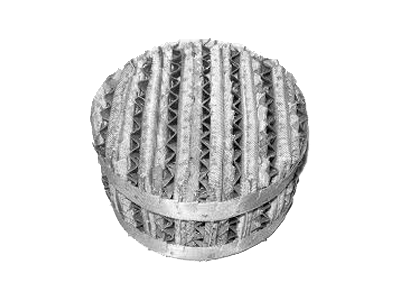
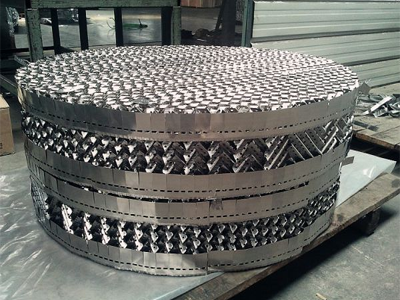
Structured glass packing (and its metal and plastic equivalents) takes a completely different approach. Instead of randomly dumped shapes, structured packing consists of corrugated sheets or grids arranged in an orderly geometric pattern inside the column. The channels created by these sheets guide both vapor and liquid in controlled paths.
The result? Much lower pressure drop compared to random packing, very high separation efficiency, and more predictable performance. Structured packing is particularly effective in vacuum distillation systems, where minimizing pressure drop is non-negotiable, and in large industrial columns, where consistency matters.
The tradeoff is cost. Structured packing is more expensive to manufacture and more complex to install. It also doesn’t handle fouling well, because the structured channels can plug up if the feed contains solids or heavy deposits.
For laboratory and small pilot-scale work, structured glass packing gives excellent theoretical plate counts in a short column length, which is why it’s popular in research settings.
Common Packing Used in Distillation Columns
When people talk about distillation column packing material, they’re usually asking about what works best for their specific separation. There’s no single answer, but here are the most widely used options across different scenarios.
Pall Rings – One of the most popular random packing types for industrial use. They’re rings with internal tongues or fingers folded inward, which improves liquid distribution and increases surface area over plain rings. Available in metal, ceramic, and plastic. They outperform plain cylindrical rings in almost every metric.
Saddle Packing (Berl Saddles, Intalox Saddles) – Saddle shapes have a curved, irregular form that resists nesting, which means the packing bed stays more open and uniform. Intalox saddles are a refined version that’s become standard in many chemical industry applications. Ceramic versions are common in acid absorption towers.
HETP Packing and Laboratory Packings – In laboratory distillation columns, the goal is often maximum theoretical plates in minimal column height. Glass helices, glass annular rings, and glass Lessing rings are all used as packing material in packed columns for research and analytical separations.
Structured Metal and Glass Packings – Sulzer, Montz, and similar types of corrugated sheet packing are widely used in industrial columns. Structured glass packing variants serve similar roles in laboratory and pharmaceutical settings.
Porous Ceramic Packings – Used in specialized gas-phase reactors where the packing itself acts as a catalyst support. Here, the packing isn’t just surface area for mass transfer; it’s the reaction site.
The Role of Reflux in Column Performance
When you’re running a distillation column, reflux is the fraction of the condensed overhead vapor that’s returned to the top of the column. The reflux ratio has a direct impact on how hard the packing has to work.
A higher reflux ratio means more liquid flowing back down through the bed, more vapor rising, and more contact between the two phases. This improves separation sharpness, but it also increases the liquid and vapor loads on the packing. If the column packing material isn’t chosen to handle that hydraulic load, you can end up with flooding, where the liquid backs up and fills the column rather than draining through.
Reflux column packing material selection always has to account for both the required mass transfer efficiency (measured in theoretical plates or HETP) and the hydraulic capacity. These two things are sometimes in tension. Packings with very high surface area often have higher pressure drop and lower capacity; packings designed for high throughput may sacrifice some efficiency.
The packing vendor or manufacturer should always provide capacity and efficiency data for the specific packing being considered. Don’t rely on generic numbers.
What Happens Inside a Packed Column
A packed column diagram typically shows a simple vertical cylinder with packing material inside, a vapor inlet at the bottom, a liquid inlet at the top, and outlets at both ends. But the actual fluid dynamics are more complex.
Liquid enters at the top and is distributed across the entire cross-section by a liquid distributor. It then flows down through the packing bed by gravity, wetting the surfaces of the packing pieces. Vapor enters at the bottom and rises upward through the voids in the packing bed. As vapor and liquid move in opposite directions (countercurrent flow), mass transfer happens at the wetted surfaces.
The key to good packed column performance is even liquid distribution. If liquid channels down one side of the column and doesn’t wet the rest of the packing, a large fraction of the packing surface is wasted. This is why liquid distributors and redistributors are just as important as the packing itself in taller columns.
Packing support grids at the bottom of the bed hold the weight of the packing without restricting vapor flow. Glass packing support plates are used in glass columns to maintain optical transparency and chemical compatibility throughout the column assembly. These supports are often perforated or slotted to allow vapor to pass through freely while bearing the load of the packing above.
Checklist for Selecting the Right Column Packing
Choosing packaging isn’t just about picking a shape and size from a catalog. Here are the questions worth working through:
What are the chemical requirements?
Some solvents attack certain plastics or metals. Glass and PTFE are the safest choices for unknown chemistries. Ceramic works well for acidic systems but can be attacked by strong alkalis.
What’s the operating pressure?
Vacuum service demands low-pressure-drop packing, which typically means structured packing or large-size random packing. High-pressure service is less sensitive to this.
What’s the column diameter?
The size of individual packing pieces should generally be no larger than 1/8 of the column diameter to avoid channeling. In a 100mm diameter glass column, you wouldn’t normally use packing larger than about 12-15mm.
What separation is needed?
If you need to achieve a very sharp separation between close-boiling components, you need high-efficiency packing and a sufficient number of theoretical plates. If the separation is easy (large volatility difference), simpler, cheaper packing may be fine.
Is fouling a risk?
If the feed contains particulates or tends to deposit solids, random packing with large openings is more forgiving than structured packing.
What’s the liquid-to-vapor ratio?
Some packings perform better over a wide range of L/V ratios; others have a narrow operating window.
Glass Columns and Glass Packing for Laboratory
Glass column packing is somewhat of its own world compared to large industrial columns. In a glass column for chemistry or pharmaceutical work, the priorities are different: absolute chemical inertness, ability to inspect the column visually, and achieving maximum theoretical plates in a short length.
Laboratory glass columns are widely used for:
- Fractional distillation of fine chemicals and solvents
- Separation of reaction mixtures
- Pilot-scale process development before scale-up
- Teaching and demonstration in academic settings
For these applications, glass helices, glass Lessing rings, glass Dixon gauze packing, and various proprietary glass structures are all used. The column itself is typically borosilicate glass (like Pyrex), and glass column adapters and fittings allow easy assembly and disassembly.
In industrial glass column applications, which are more common in the pharmaceutical, food processing, and specialty chemical industries than in heavy chemical processing, the columns are larger and often fitted with all-glass internals, including glass packing support plates and glass liquid distributors.
Installing and Loading Column Packing Properly
Loading packing incorrectly can ruin the performance of even the best materials. Here’s what actually matters during installation:
Wet loading vs. dry loading – For glass and ceramic packings, wet loading (filling the column with liquid first, then pouring packing in) produces a more uniform bed and reduces the risk of breakage. Dry loading is faster but can result in bridges and voids.
Don’t compress random packing – Random packing beds are self-supporting. Trying to compress or tamp down the packing creates dense zones that increase pressure drop and reduce performance.
Level the bed before adding more – After loading a section, level the top surface before adding the next section. This helps maintain a uniform bed height.
Use redistributors in tall columns – In columns more than about 3-5 times the column diameter in bed height, liquid tends to migrate toward the walls. A liquid redistributor halfway up the bed corrects this.
Check the packing support – Make sure the packing support grid or plate is properly seated and won’t flex or fail under the weight of the loaded packing plus operating liquid holdup.
Packed Column Reactor Applications
Beyond simple distillation, packed columns are used as reactors in their own right. A packed column reactor uses the packing to hold catalyst material, distribute reactants evenly, or provide a controlled environment for gas-liquid reactions.
In some configurations, the packing itself is the catalyst (catalytic distillation). In others, the packing serves only a mass transfer role while a catalyst is incorporated separately. Packed column reactors are used in processes like hydrogenation, esterification, and gas scrubbing, where reaction and separation need to happen simultaneously.
The design principles are similar to those for distillation packings, but the packing material must also be compatible with the catalyst system and the reaction conditions, which may include elevated temperatures and pressures.
Maintenance and Troubleshooting in Packed Columns
Even well-designed systems run into problems. Here are the most common issues and what to look for:
Flooding – Pressure drop across the packing rises sharply, liquid backs up, and the column loses separation efficiency. Causes include operating above design vapor or liquid rates, packing settling or compaction, or contamination of the bed.
Channeling – Liquid bypasses most of the packing and flows down a few preferential paths, usually along the column wall or through gaps in the bed. This drastically reduces efficiency without necessarily showing up as a pressure drop increase.
Fouling or plugging – Deposits of solids, polymers, or salts block the packing voids and reduce both capacity and efficiency. May require shutdown and washing or replacement of the packing.
Packing breakage – Glass and ceramic packings can break during loading or operation. Broken packing pieces can migrate to the packing support and cause plugging or structural issues.
Regular inspection of glass columns during operation is one of the big advantages of using glass construction. You can actually see if the liquid distribution looks right, if there’s flooding, or if there are any obvious flow problems.
How Goel Impex is Supplying Glass Column Packing for Industrial and Laboratory Use
For teams sourcing glass column packing material in India, Goel Impex is a recognized packed column manufacturer offering a range of laboratory and industrial glass column components. Our catalog includes glass column packing in various sizes and configurations, glass packing support plates, glass column adapters, and complete column assemblies for distillation and separation work.
If you’re specifying packing for a glass column application, working with a supplier who understands both the material requirements and the process side of things makes the job considerably easier.
Putting It All Together
Column packing is one of those things that look simple from the outside but have a lot of depth once you get into the specifics. The right packing material, the right size, the right installation, and the right operating conditions all have to align for a packed column to perform as designed.
For standard chemical laboratory work, glass column packing in the appropriate size for your column diameter, paired with good liquid distribution hardware, will handle most separations reliably. For industrial applications, the choice gets more application-specific, and it’s worth doing a proper hydraulic and efficiency calculation before committing to a packing type.
Whether you’re running a small glass fractional distillation column in a lab or managing a large absorption tower in a chemical plant, understanding what’s inside the column and why it’s there makes you a better operator and a smarter buyer.