
Steam distillation is the method used to produce most of the world’s essential oils. Steam passes through plant material; the heat releases volatile aromatic compounds, and those compounds travel with the vapour into a condenser where both return to liquid. The oil floats, the water sinks, and you separate the two. That is the whole idea, and it has not changed much in three hundred years.
What has changed is the equipment, and that is where most producers either make money or lose it.
This guide covers how the steam distillation process works, what goes into a proper distillation unit, what yields you can realistically expect from different crops, and how to pick a capacity that matches your daily biomass. Written for people who are buying or running equipment, not for people writing a school assignment.
What steam distillation actually does
Essential oils are volatile. Left in open air, they evaporate on their own, slowly. The problem is that many of the aromatic compounds inside a plant boil well above 200°C, and heating a plant to 200°C destroys the very compounds you are trying to collect.
Steam solves this. When two immiscible liquids are heated together, they boil at a temperature below the boiling point of either one alone. So an oil compound that would normally need 220°C comes over at just under 100°C when water vapour is carrying it. The plant material never sees a temperature that would scorch it.
This is why steam distillation stayed dominant even after supercritical CO2 and microwave-assisted methods arrived. It is cheap, it scales, and for most crops the aromatic profile it produces is the one buyers expect.
If you want the wider view of how this compares to cold pressing, solvent extraction and enfleurage, we covered that separately in our guide to essential oil extraction methods.
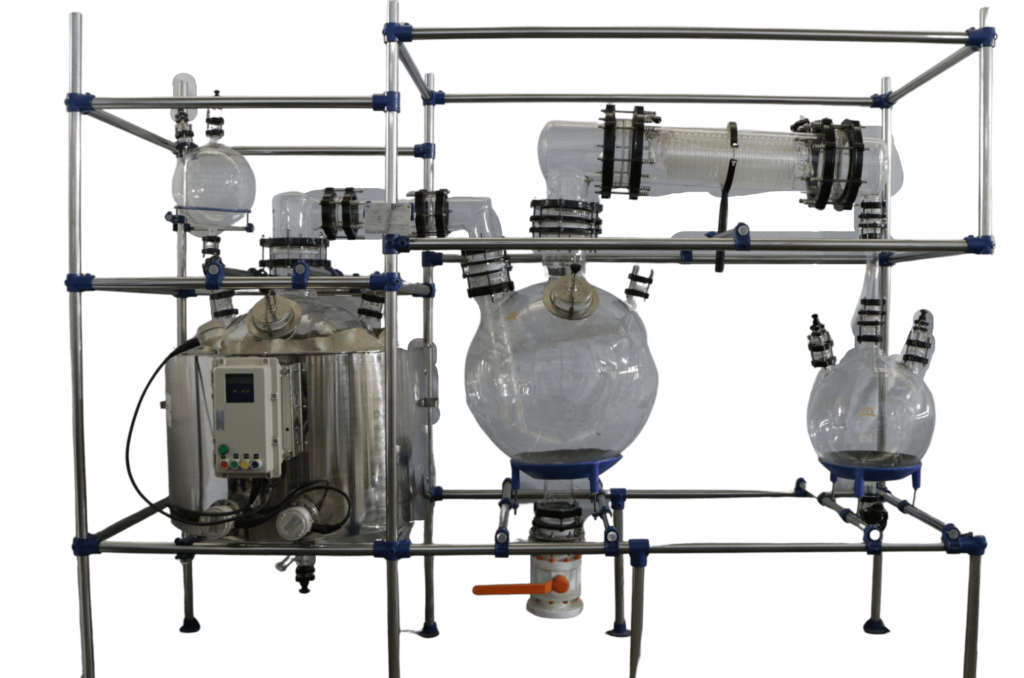
How the steam distillation process works
1. Loading the plant material
Harvested material goes into the reactor vessel, sitting on a perforated support plate above the base. It has to be packed evenly. Pack too loose and steam channels straight through the gaps without touching most of the biomass. Pack too tight, and the steam cannot penetrate at all.
Some crops need pre-treatment. Lemongrass and citronella are chopped. Vetiver roots are soaked. Clove buds are lightly crushed. Lavender is usually wilted for a day, which cuts water content and improves oil concentration per batch.
2. Generating and injecting steam
Water is heated in a separate vessel, and the steam is piped into the reactor from below. It rises through the packed bed, ruptures the oil-bearing structures in the plant tissue, and carries the released compounds upward as vapour.
Keeping the steam generator separate from the plant material is what distinguishes true steam distillation from hydrodistillation, where the botanicals sit directly in boiling water. That distinction matters more than most people assume, and we will come back to it.
3. Condensing the vapour
The oil and water vapour mixture leaves the top of the reactor and enters the condenser, where cooling water pulls the heat out and returns everything to liquid form.
4. Separating oil from water
The condensate flows into a receiver, usually a Florence flask. Most essential oils are lighter than water and collect on top, so you draw the water off from the bottom. A few, including clove and cinnamon bark oil, are denser than water and settle underneath, which means the separator has to be configured the opposite way round.
Steam distillation vs hydrodistillation vs vacuum distillation
| Steam distillation | Hydrodistillation | Vacuum distillation | |
| Plant contact | Steam only | Submerged in boiling water | Steam or water, under reduced pressure |
| Typical temperature | 100°C | 100°C | 40°C to 80°C |
| Best for | Leaves, grasses, woods, most commercial crops | Powdered material, resins, crops that clump | Delicate florals, citrus, heat-sensitive compounds |
| Cycle time | Moderate | Longer | Shortest at temperature |
| Risk | Channelling if packed badly | Overheating and hydrolysis of delicate compounds | Higher capital cost |
What the research actually shows
Published comparisons are more interesting than the marketing on most equipment websites, because the results do not all point the same way.
| Crop | Plant part | Hydrodistillation | Steam distillation |
| Clove | Buds | 9.71% | 4.99% |
| Bay laurel | Leaves | 0.95% | 0.79% |
| Fennel | Seeds | 2.47% | 3.47% |
| Rosemary | Aerial parts | 0.44% | Higher |
| Basil (Ocimum spp.) | Leaves, flowers, stems | Lower | Consistently higher |
Three things fall out of this.
Steam usually wins on yield, but clove is a striking exception. Hydrodistillation pulled almost double the oil from clove buds, and the reason is practical rather than chemical: steam distillation of clove tends to form a stubborn emulsion in the distillate, and oil trapped in that emulsion is oil you do not recover.
Yield and quality are not the same question. In the bay laurel study, hydrodistillation gave the higher yield while steam distillation produced oil containing 73 identified compounds against 54, with stronger antimicrobial and antioxidant activity. If you are selling into a market that pays for GC-MS profile rather than volume, that trade goes the other way.
Method upgrades can beat method switching. On fennel seed, superheated steam reached 5.24% against 3.47% for conventional steam and 2.47% for hydrodistillation. Same basic principle, better execution.
What sits inside a steam distillation unit
The reactor vessel
This is where the biomass goes. Commercial glass units run from 10 litres for trials up to 200 litres for production batches. Glass matters here for a reason we will get to.
The steam generator
A separate heated vessel producing steam at a controlled rate. Mantle rating scales with reactor size, roughly 1 kW on a 10-litre unit up to around 8 kW at 200 litres.
The condenser
Buyers compare reactor capacity and stop there. The condenser is what actually limits you.
Look at how heat transfer area scales across a standard range. A 10 litre unit carries 0.35 m² of condenser area, a 20 litre unit 0.50 m², and then 50 litre and 100 litre units both carry 1.50 m². That flat spot between 50 and 100 litres is not an error. It reflects the fact that condenser duty is driven by steam rate, not vessel volume, and a 100 litre batch run gently needs no more cooling than a 50 litre batch run hard.
The practical consequence: if you plan to push steam aggressively to shorten cycle times, ask about condenser area before you ask about reactor size. Undersized condensers vent vapour, and vented vapour is lost oil. Our glass condensers are specified against expected steam load rather than against nominal vessel volume.
The receiver and separator
Sized to hold a full batch of condensate. A 10 litre unit typically pairs with a 5 litre receiver, a 200 litre unit with 50 litres.
Sizing a unit to your daily biomass
Work backwards from how much plant material you process per day, not from how much oil you want.
| Unit | Reactor | Mantle | Addition vessel | Condenser HTA | Receiver | Suits |
| EOSD 10 | 10 L | 1 kW | 5 L | 0.35 m² | 5 L | R&D, trials, new crop testing |
| EOSD 20 | 20 L | 1.8 kW | 5 L | 0.50 m² | 5 L | Small farm, pilot batches |
| EOSD 50 | 50 L | 3.6 kW | 20 L | 1.50 m² | 20 L | Small commercial production |
| EOSD 100 | 100 L | 5.4 kW | 20 L | 1.50 m² | 20 L | Established producers |
| EOSD 200 | 200 L | 8.1 kW | 50 L | 2.25 m² | 50 L | Contract distillation, export volume |
A rough planning rule: assume three to four batches per shift once your team is trained, and remember that fresh material takes far more volume per kilogram than dried. A 200 litre reactor packed with fresh lemongrass holds nowhere near what the same vessel holds packed with dried seed.
Every Goel Impex steam distillation unit can be built to run at atmospheric pressure or under full vacuum, which is worth specifying at the order stage if you expect to add delicate florals later. Retrofitting vacuum capability afterwards costs more than building it in.
The four parameters that decide your yield
Steam rate
Too low and compounds stay locked in the plant tissue. Too high and you flood the condenser and blow uncondensed vapour out of the system. Insufficient steam pressure gives incomplete extraction and reduced yields, which is a well-documented failure mode rather than an opinion.
Distillation time
Here is the number most producers find surprising. In steam distillation of rosemary, more than 80% of the total oil comes over in the first ten minutes. Yield rises quickly at the start and then flattens hard.
Running long past that point burns fuel, adds hours, and risks degrading the compounds already collected. Work out the point of diminishing return for each crop you handle and stop there. For many leaf and grass crops, that is 45 to 90 minutes, not the four hours some operators default to.
Packing density
Uniform packing beats heavy packing. Channelling is the most common cause of a batch underperforming, and it leaves no obvious evidence afterwards.
Pressure
Standard steam distillation runs at atmospheric. Dropping to vacuum lowers the boiling point and protects thermolabile compounds, at the cost of a vacuum system. Rose, jasmine and citrus peel are the usual candidates. Partial degradation of heat-sensitive components is a real risk when hot steam is used at atmospheric pressure, and for high-value florals that degradation shows up directly in the price you get.
Why hydrosol is worth collecting properly
The water that separates is hydrosol, and a lot of small producers pour it away.
Hydrosol carries the water-soluble aromatic fraction. It sells into skincare, cosmetics and food flavouring, and for crops with low oil yield it can contribute a meaningful share of revenue from the same batch. Rose and lavender hydrosol in particular have a real market.
Collecting it well needs a properly sized Florence flask and a bit of discipline about storage, since hydrosol is microbiologically fragile and needs cool, sealed, dark conditions.
Why borosilicate glass, and when stainless is fine
Essential oils contain terpenes, aldehydes and phenols. Some of these react with metal surfaces, and the products of those reactions show up as off-notes and colour shifts in the finished oil. Clove oil against mild steel is the textbook example.
Glass is chemically inert, so nothing leaches and nothing reacts. You also get full visibility, which sounds like a small thing until you have watched a batch foam toward the vapour line and been able to cut the heat before it carried over.
Stainless steel is perfectly reasonable for large-volume, single-crop, low-reactivity work where visibility does not matter, and throughput does. Where glass earns its cost is in multi-crop operations, reactive material, and anyone selling on GC-MS profile to export buyers. We go deeper on the material science in our article on borosilicate glassware.
Five mistakes that cost operators oil
Over-distilling. Covered above. Most of your oil arrives early.
Undersized condenser. Vapour that escapes uncondensed is invisible loss. Nobody notices it on the yield sheet because there is nothing to see.
Discarding hydrosol. Free product going down the drain.
Delayed processing after harvest. Cut material starts losing volatiles within hours. Lemongrass processed the same day beats lemongrass processed two days later, and the gap is larger than most people expect.
Wrong separator geometry for dense oils. If you distil clove or cinnamon bark with a standard light-oil Florence flask, you will lose product every batch and wonder why.
Talk to Goel Impex about your distillation setup
Goel Impex has been building borosilicate process glassware in Vadodara for over two decades, and our essential oil distillers are built for producers who need consistent output batch after batch rather than a single good run.
Units are available from 10 to 200 litres, in steam and vacuum configurations, with condenser area specified against your actual steam load. If you are working with an unusual crop or need a configuration outside the standard range, we build custom.
Tell us what you are distilling and how much of it you handle in a day, and we will recommend a capacity and configuration. Get in touch or download the essential oil distillers catalogue for full specifications.





One reply on “Steam Distillation Yields by Crop: Process, Cycle Times and Unit Sizing”
[…] nature, because the raw material is solid plant matter loaded into the still in lots. Our guide to steam distillation yields by crop covers that process in […]