Borosilicate Glass & Borosilicate Glassware
Borosilicate Glass 3.3
We fabricate precision-engineered glass components using premium raw materials sourced from globally recognized manufacturers, ensuring superior quality and performance. Upon request, we also manufacture components using leading European Borosilicate Glass 3.3 tubing that complies with DIN ISO 3585 and ASTM E438 Type I, Class A standards—delivering exceptional dimensional accuracy, outstanding chemical resistance, and superior optical clarity comparable to the world’s foremost producers.

Borosilicate Glass 3.3 is the most reliable and standardized material for constructing plant equipment and pipeline systems across the chemical, dyestuff, food processing, pharmaceutical, and petrochemical industries. Its expanding global adoption is driven by significant advantages over conventional materials, including high thermal shock resistance, excellent corrosion resistance, mechanical strength, and long service life—making it the ideal choice for demanding industrial applications.
Key Features & Advantages of Borosilicate Glassware
- Outstanding corrosion resistance against acids, alkalis, and chemical solvents
- Excellent thermal shock resistance with low thermal expansion
- Smooth, pore-free surface preventing contamination and residue buildup
- High transparency for easy process monitoring
- Catalytically inert – does not interfere with chemical reactions
- No impact on taste or odor of processed materials
- Physiologically inert and non-toxic
- Long service life with minimal maintenance
Borosilicate glass is widely preferred in industrial applications due to its exceptional chemical durability and thermal stability. It is engineered using a carefully controlled composition of high-purity oxides, primarily Silica (SiO₂) and Boron Oxide (B₂O₃), along with selected modifiers that enhance strength, resistance, and performance under demanding conditions.
The chemical and physical characteristics of borosilicate glass are directly influenced by its precise composition, making it highly reliable for process industries, laboratories, and chemical handling systems.
Chemical Composition
The composition of borosilicate glass used for chemical plants has the following approximate composition:
| SiO2 (Silicon Dioxide) – 80.6% |
B2 O2 (Boron Trioxide) – 12.5% |
| Na2O (Sodium Oxide) – 4.2% |
Al2O3 (Aluminium Oxide) – 2.2% |
Borosilicate glass is an oxide glass primarily composed of silica and boron trioxide, with smaller amounts of alkali and alumina. This specific composition provides excellent chemical resistance, thermal stability, and mechanical strength, making it ideal for chemical process equipment, reactors, pipelines, and storage vessels.
Resistance to Chemicals
Borosilicate glass is highly resistant to most chemicals and remains inert when exposed to the majority of acids, alkalis, and organic substances. However, it is not resistant to hydrofluoric acid (HF), phosphoric acid (H₃PO₄), and hot, concentrated caustic solutions. Among these, hydrofluoric acid has the most severe effect and can attack borosilicate glass even at very low concentrations measured in parts per million (PPM).
Phosphoric acid and caustic solutions generally do not affect borosilicate glass at ambient temperatures. However, at elevated temperatures, corrosion may occur depending on concentration and operating conditions. Caustic solutions with concentrations up to 30% can typically be handled safely at normal room temperature.
Under actual process conditions, factors such as temperature, turbulence, pressure, and the presence of trace contaminants can influence the rate of chemical attack. Therefore, exact corrosion rates for caustic solutions cannot be universally defined and should be evaluated based on specific operating environments.
Thermal Properties of Borosilicate Glass 3.3
- Linear Coefficient of Thermal Expansion
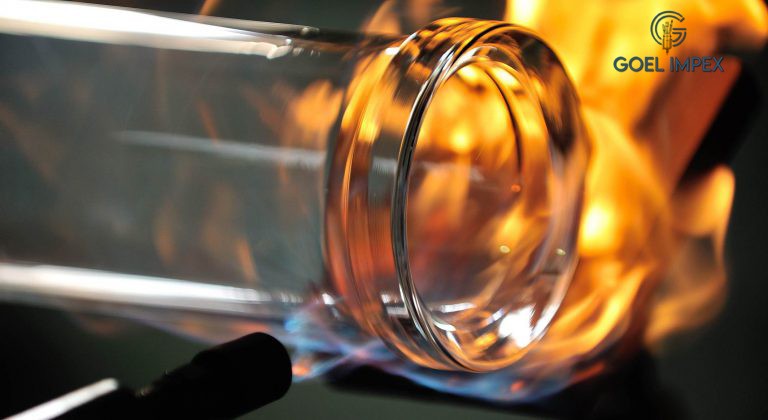
The coefficient of thermal expansion of borosilicate glass within the temperature range of 0–300°C is 3.3 × 10⁻⁶/°C. This exceptionally low expansion rate, compared to conventional glasses and metals, ensures excellent dimensional stability under temperature variations. Due to this characteristic, borosilicate glass is widely recognized as low-expansion borosilicate glass, making it ideal for applications involving thermal cycling and high temperature resistance.
- Specific Heat
The average specific heat of borosilicate glass between 25°C and 300°C is approximately 0.233 Kcal/kg·°C. This property enables the material to absorb and retain heat efficiently while maintaining structural integrity, making it suitable for thermal processing and industrial applications.
- Thermal Conductivity
Borosilicate glass has a thermal conductivity of approximately 1.0 Kcal/hr·m·°C within the permissible operating temperature range. This ensures uniform heat distribution and minimizes the risk of thermal stress, contributing to reliable performance in high-temperature environments.
Annealing
Annealing is a controlled heat treatment process in which the glass is heated to a specific temperature and held for a defined period to relieve internal stresses developed during manufacturing.
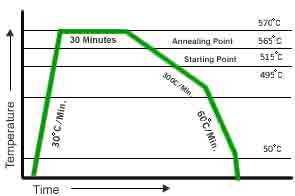
This is followed by gradual and carefully controlled cooling to prevent the formation of new stresses. Proper annealing enhances the mechanical strength, durability, and long-term performance of borosilicate glass.
Reshapeing
The following graph depicts the typical temperatures corresponding to specific viscosity levels required for reshaping borosilicate glass:
| Lower cooling temperature | 1024 poise | 515°C |
| Upper cooling temperature | 1013 poise | 565°C |
| Softening point | 107 poise | 795°C |
| Reshapeing point | 104 poise | 120° C |
This data represents the standard thermal behavior of borosilicate glass during controlled heating and reshaping processes, ensuring precision and structural integrity.
Mechanical Properties of Borosilicate Glass
Borosilicate glass is known for its excellent mechanical strength and reliability in demanding industrial environments. Like all glass materials, it is inherently non-ductile, meaning it does not deform plastically before breaking. As a result, localized stresses at surface irregularities or microscopic flaws cannot redistribute, which can cause variations in breakage strength.
Under controlled conditions, borosilicate glass exhibits an average tensile strength of approximately 700 kg/cm², demonstrating its capability to withstand significant mechanical loads. To ensure safe and dependable operation, engineering designs incorporate a substantial factor of safety when determining wall thickness and pressure ratings. This approach allows borosilicate glass equipment to perform safely under specified working pressures, even in continuous industrial use.
These properties make borosilicate glass highly suitable for pressure vessels, reactors, pipelines, and other critical process equipment where strength, durability, and safety are essential.
Optical Properties of Borosilicate Glass
Borosilicate glass offers outstanding optical clarity due to its negligible absorption in the visible light spectrum, making it completely clear and colorless. This transparency allows operators to easily monitor internal processes, fluid flow, and reactions without obstruction.
One of its most valuable optical characteristics is its excellent transmission of ultraviolet (UV) light. This property is particularly important in photochemical applications, where UV radiation is required to initiate or accelerate chemical reactions.
Because of its high UV transparency, borosilicate glass is ideal for processes such as:
- Chlorination
- Sulpho-chlorination
- Photochemical synthesis
- UV-assisted chemical reactions
This combination of optical clarity and UV transmission makes borosilicate glass the preferred material for reactors and equipment used in chemical, pharmaceutical, and research industries where process visibility and UV compatibility are critical.
Permissible Operating Conditions for Borosilicate Glass
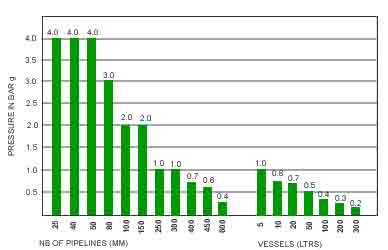
The permissible internal operating pressure of borosilicate glass components depends on the nominal diameter of the glass and the operating temperature. In assemblies consisting of multiple components—such as vessels, filters, and heat exchangers—the overall permissible internal gauge pressure is always determined by the component with the lowest allowable operating pressure.
All borosilicate glass components are designed and suitable for operation under full vacuum conditions.
Pressure values are expressed in bar, which is a unit of absolute pressure. The maximum recommended working pressure values indicated refer to gauge pressure, meaning pressure above atmospheric pressure.
Working Temperature
Borosilicate glass maintains its mechanical strength and structural integrity up to temperatures approaching its strain point. However, the practical maximum operating temperature is determined by the temperature differential between the process media inside the equipment and the external environment. When borosilicate glass is not exposed to rapid temperature changes that may cause thermal shock, it can be safely operated at temperatures up to 250°C.
In complete systems where borosilicate glass is combined with other materials such as PTFE, the recommended maximum operating temperature is typically limited to 200°C, in accordance with the thermal limitations of these associated components. Additionally, operating temperatures may need adjustment based on process conditions such as internal pressure, thermal cycling, and rapid heating or cooling.
The resistance of borosilicate glass to thermal shock—defined as sudden heating or cooling—depends on several factors, including operational stresses, mounting and support conditions, and the thickness of the glass. Sudden and extreme temperature changes should therefore be avoided. Under controlled conditions, borosilicate glass can withstand temperature differentials of up to 120°C.
At sub-zero temperatures, the tensile strength of borosilicate glass increases, allowing safe operation at temperatures as low as –50°C, particularly for XTRONG components and systems.
Composite Materials
Over the past two decades, significant advancements have been made in highly corrosion-resistant materials used for process plant construction. Notable examples include PTFE, tantalum, titanium, graphite, and Borosilicate 3.3 glass—each offering exceptional durability and chemical resistance in demanding environments.
By combining these advanced materials and leveraging their individual strengths, manufacturers can design process equipment that ensures superior safety, extended service life, and cost-effective performance. This strategic use of composite corrosion-resistant materials enables reliable operation even under the most aggressive chemical conditions.
Borosilicate Glass with PTFE
Borosilicate glass combined with PTFE plays a critical role in the construction and performance of glass process equipment. This combination is widely used in components such as seals, bellows, stirrers, pumps, heat exchangers, column internals, and other glass assemblies where durability and chemical resistance are essential.
PTFE (Polytetrafluoroethylene) is integrated with borosilicate glass due to its exceptional mechanical strength and thermal stability. It offers near-universal chemical compatibility, making it suitable for handling a wide range of aggressive fluids and process conditions. PTFE also provides excellent resistance to corrosion and wear, ensuring long service life with minimal maintenance requirements.
One of the key advantages of PTFE is its non-wetting surface, which prevents material adhesion and improves operational efficiency. Additionally, PTFE maintains its stability even under cryogenic conditions, making it reliable for demanding industrial applications.
Service Temperature Range:
PTFE is suitable for continuous operation within a temperature range of –50°C to +200°C, ensuring dependable performance across both low and high temperature environments.
Electrical Characteristics of Borosilicate Glassware
Borosilicate glass is an excellent electrical insulator due to its inherently low electrical conductivity. Its surface conductivity is negligible and primarily depends on the amount of moisture absorbed on the glass surface.
At elevated temperatures, borosilicate glass maintains strong insulating properties, with a specific conductivity of approximately 10⁻⁶ ohm/cm at 200°C. Additionally, its dielectric constant varies depending on the frequency of the applied electrical current, making it suitable for a wide range of electrical and electronic applications.
Density of Borosilicate Glassware
Borosilicate glass is known for its excellent mechanical strength and dimensional stability, making it ideal for demanding industrial applications.
- Density of glass at 20°C(J)=2.23g/cc
- Modulus of elasticity (E)=6.3 KN/mm2
- Poissions ratio=0.2
These properties contribute to borosilicate glass’s superior resistance to mechanical stress, thermal shock, and structural deformation, ensuring long-term reliability in critical process environments.
With X Bonding
Without X Bonding
Extra Protection for Glass Components with 'X Bonding'
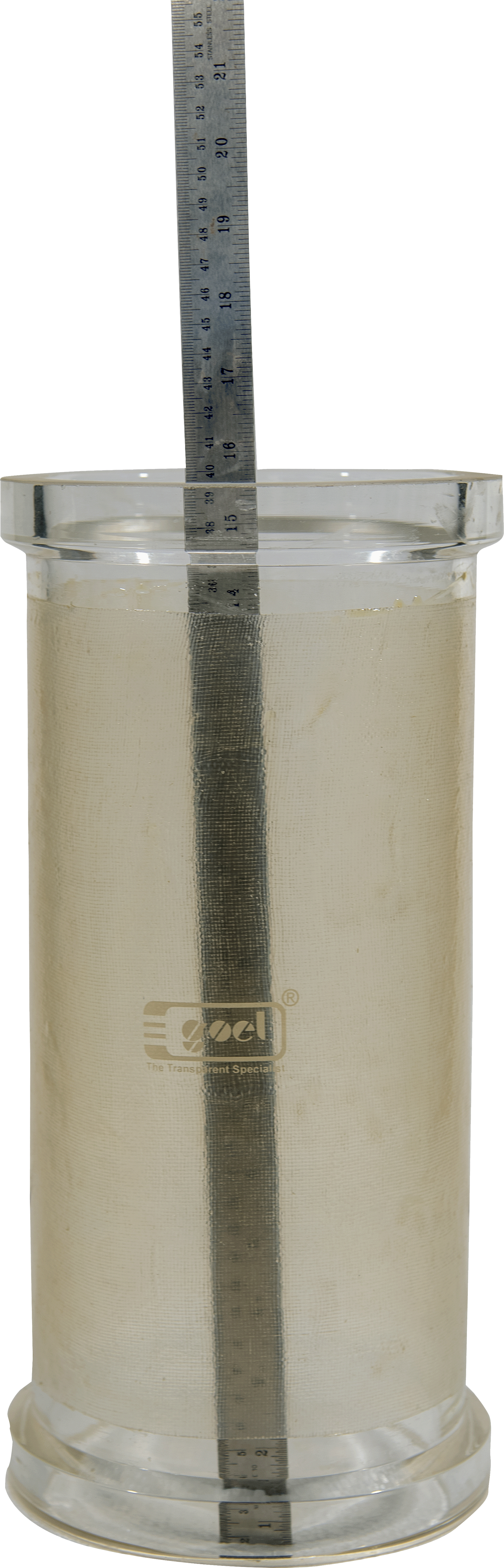
X-Bonding provides enhanced protection for standard glass components by reinforcing them with a specialized protective layer. This advanced system significantly improves safety and reliability, especially in demanding industrial environments.
The primary advantage of X-Bonding is its ability to contain glass fragments in the event of accidental breakage. The bonded outer layer helps reduce the risk of injury, prevents the release of hazardous or corrosive fluids, and minimizes loss of valuable process materials. This added protection helps ensure safer operation and reduces potential downtime and product loss.
X-Bonding consists of a durable glass-reinforced fiber coating applied to the external surface of the glass component. This coating increases the overall mechanical strength and impact resistance of the glass. While the coating may slightly reduce optical clarity—resulting in a translucent rather than fully transparent appearance—it delivers a substantially higher level of safety and durability.
Permissible Operating Temperature
The maximum permissible operating temperature for X-Bonded components is 130°C, unless restricted by the lower temperature rating of any individual component used within the assembly. Always ensure that the operating temperature does not exceed the specified limit of the most temperature-sensitive component.
Permissible Operating Pressure
X-Bonded components are designed to operate at the same permissible pressure levels as standard borosilicate glass components, ensuring consistent performance and reliability under normal operating conditions.
Thermal Shock Resistance
Although X-Bonding provides additional thermal insulation, the thermal shock resistance remains equivalent to that of standard glass components. Proper operating procedures should be followed to avoid sudden temperature fluctuations that may affect component integrity.
Frequently Asked Questions
What is borosilicate glass?
Borosilicate glass is a high-performance glass made from silica and boron oxide, designed to provide excellent resistance to heat, chemicals, and thermal shock. It is widely used in laboratory equipment, industrial process plants, and chemical handling applications due to its durability and stability.
Why is borosilicate glass preferred in chemical and industrial applications?
Borosilicate glass is preferred because it offers exceptional chemical resistance, high thermal stability, and low expansion under temperature changes. It remains inert to most acids, solvents, and chemicals, ensuring safe and contamination-free processing.
What is Borosilicate Glass 3.3?
Borosilicate Glass 3.3 is a premium industrial glass with a very low thermal expansion coefficient of 3.3 × 10⁻⁶ /°C, making it highly resistant to thermal shock and temperature fluctuations. It is commonly used in reactors, pipelines, and laboratory glassware.
What are the main properties of borosilicate glass?
Key properties of borosilicate glass include:
- High resistance to thermal shock
- Excellent chemical resistance
- Low thermal expansion
- High optical clarity
- Long service life and durability
What chemicals can borosilicate glass resist?
Borosilicate glass resists most acids, organic solvents, water, and salt solutions. However, hydrofluoric acid, hot phosphoric acid, and strong caustic solutions at high temperatures can affect its surface.
What is the temperature resistance of borosilicate glass?
Borosilicate glass can withstand high temperatures and sudden temperature changes without cracking. Its low thermal expansion allows it to perform reliably in applications involving heating, cooling, and thermal cycling.
Where is borosilicate glass used?
Borosilicate glass is widely used in:
- Chemical processing plants
- Pharmaceutical industries
- Laboratory glassware
- Industrial reactors and pipelines
- Scientific and research equipment
What is borosilicate glass made of?
Borosilicate glass is composed mainly of silica (around 80%), boron oxide (about 12–13%), and small amounts of sodium oxide and aluminum oxide, which provide strength, chemical resistance, and thermal stability.
What makes borosilicate glass better than regular glass?
Compared to standard glass, borosilicate glass offers superior thermal shock resistance, higher chemical durability, and longer service life. It expands less under heat, reducing the risk of cracking or failure in industrial use.
Is borosilicate glass suitable for high-temperature industrial processes?
Yes, borosilicate glass is ideal for high-temperature industrial and chemical processes due to its low expansion rate, high heat resistance, and excellent chemical stability, ensuring safe and reliable operation.






Vacancy for Senior Process Design Engineer